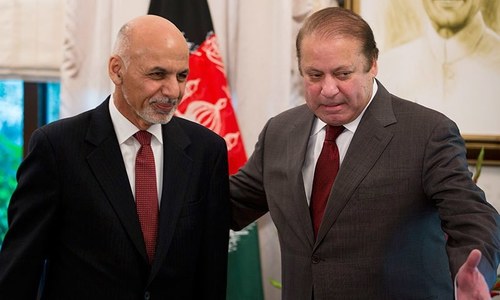
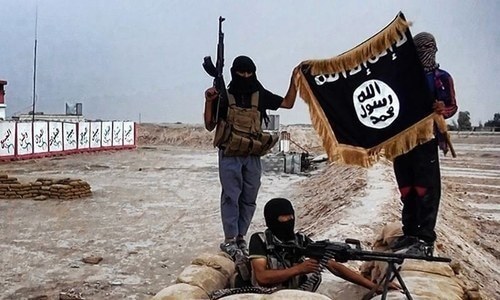
WASHINGTON: The rivalry between Afghanistan and Pakistan has created room for terrorists of the militant Islamic State (IS) group to build a foothold in the region, recent US reports on the issue point out.
Last week, the United States hosted a 68-nation conference in Washington to formulate a joint strategy for combating the IS terrorists. In his address to the conference, US Secretary of State Rex Tillerson not only noted the group’s presence in the Pak-Afghan region but also pointed out that the group had carried out “many terrorist attacks in Afghanistan and Pakistan”.
In the region, the group is known as the Islamic State of Khorasan (ISK) and operates from its bases in the Afghan areas along the Pak-Afghan border.
In a recent report on ISK, the Congress-funded US Institute of Peace underlines the link between this group and Pakistani militant organisations to show how the Afghan-Pakistan rivalry benefited the terrorists.
The USIP report quotes from a July 2016 report by the Afghanistan Analysts Network, which claims that Afghanistan’s intelligence agency, “the National Directorate of Security, has supported the militant organisation Lashkar-i-Islam and elements of TTP since 2014 “with the aim of playing these militants against Pakistan in retaliation for Pakistan’s long-time support of the Afghan Taliban.” Fighters from both groups later joined ISK.
The USIP report, however, says that “a regionally supported political settlement with the Taliban” is the best way of defeating the IS in the Pak-Afghan region.
The Congressional Research Service (CRS), which provides analytical reports to US lawmakers, argues that US military strikes have also been very effective in reducing ISK’s influence in the region.
USIP suggests “establishing border security” is “key to any serious attempt at rooting out ISK” but notes that both Afghanistan and Pakistan “appear willing to sacrifice long-term regional security to enable their own — ultimately uncontrollable — militant proxies to create insecurity for their neighbour across the Durand Line”.
The report warns that “as long as these short-sighted tactics are not reversed, international forces, and the international community more broadly, risk getting drawn into a fight with the IS that is essentially the same mix of territorial, regional-geopolitical, and hyper-local conflicts that have characterised Afghanistan-Pakistan relations for decades”.
Published in Dawn, March 29th, 2017