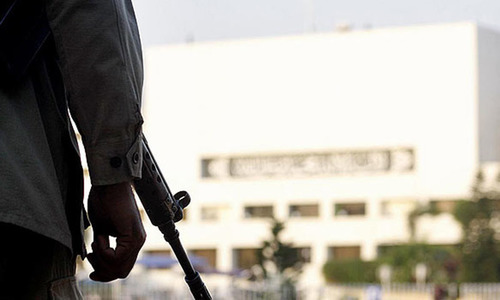
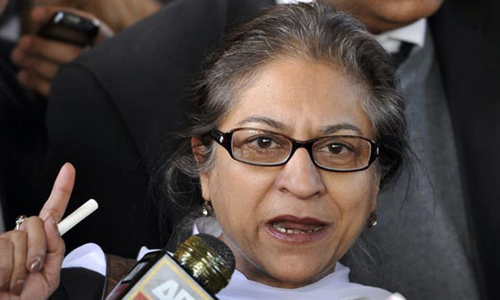
The National Assembly on Tuesday evening passed the 28th Constitutional Amendment Bill to reinstate military courts with 255 votes in favour and four against, surpassing the two-thirds majority required for the measure.
The bill, presented by Minister for Law and Justice Zahid Hamid, states on the outset that "an extraordinary situation and circumstances still exist which demand continuation of the special measures adopted for expeditious disposal of certain offences" as the reasons necessitating the revival of military courts.
" ... [T]he Constitution (Twenty-first Amendment) Act, 2015 (I of 2015) was passed (with a sunset clause of two years) enabling trial under the Pakistan Army Act, 1952 for expeditious disposal of cases related to terrorism.
"These measures have yielded positive results in combating terrorism. It is, therefore, proposed to continue these special measures for a further period of two years through this Constitution Amendment Bill," reads the Statement of Objects and Reasons of the bill.
The 28th Constitutional Amendment will now be presented to Senate, where it will need two-thirds approval in order to become law.
If the bill is passed, it will reinstate military courts for a period of two years starting Jan 7, 2017 — the date on which military courts had lapsed under the previous arrangement.
Prime Minister Nawaz Sharif, after an absence of seven months from the National Assembly, was present for Tuesday's session.
Lawmakers from the Jamiat-i-Ulema Islam-Fazl (JUI-F) abstained from voting on the bill, saying they had had reservations regarding its legal language, specifically with the phrase “terrorism in the name of religion”.
Criticising the government, Pakistan Muslim League-Zia MNA Ijazul Haq noted that if the National Action Plan had been implemented in letter and spirit, the need to revive military courts would not exist.
The Pakistan Army (Amendment) Act 2017 was also passed earlier in the session.
Military courts were disbanded on Jan 7 after a sunset clause included in the legal provisions under which the tribunals were established, expired.
Till recently, the government and the opposition had struggled to reach a consensus on reviving the courts despite frequent discussions.
The primary concern of critics was the mystery surrounding military court trials: no one knows who the convicts are, what charges have been brought against them, or what the accused's defence is against the allegations levelled.
Proponents say the courts act as an "effective deterrent" for those considering violent acts.