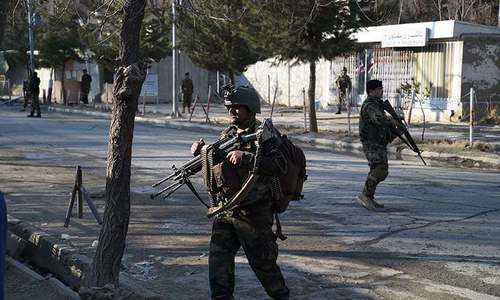
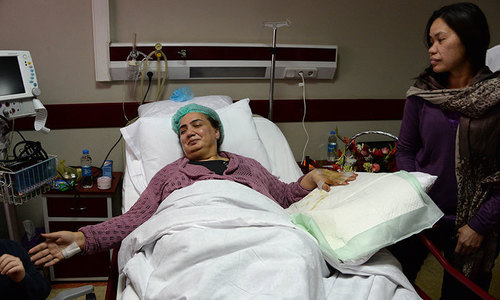
Insiders including two interns were among the attackers who launched a gun-and-grenade assault this week on Afghanistan's largest military hospital, killing more than 100 people, multiple surviving staff and security sources told AFP.
The six-hour attack on the Sardar Daud Khan hospital on Wednesday began when a suicide bomber blew himself up at the back entrance, paving the way for gunmen disguised as doctors, according to the official account of the assault.
But multiple survivors spoke of a "simultaneous massacre", revealing that attackers already positioned inside the facility ─ some of them familiar staff ─ launched a killing spree with guns, grenades and knives immediately after the blast.
They allegedly included two interns in their 20s who had worked in the facility for months, according to a hospital official who guided Afghan special forces to rescue the victims.
"We all knew them," he told AFP, requesting anonymity as he was not authorised to talk to the media.
"One of them blew himself up and the other was shot down by special forces."
Another doctor, badly wounded in the attack, said one of the interns had worked under him.
"He was my student, a familiar face... It was painful to see him shooting at everyone," he told AFP.
The suspected involvement of the two 'interns' was corroborated by an Afghan security source.
The carnage inside the heavily guarded hospital points at a spectacular intelligence failure and spotlights how insurgents have managed to infiltrate top government and military institutions in Afghanistan.
Defence Ministry Spokesman Mohammad Radmanish conceded that "the attack was carried out from both outside and inside".
"This could not have been possible without the help of people inside," Radmanish told AFP. "Some individuals are being questioned."
Savage assault
The militant Islamic State (IS) group claimed it was behind the attack via its propaganda agency Amaq ─ hours after the Taliban denied responsibility.
Officials have also cast doubt that the attack was the handiwork of IS, a group seeking to expand its foothold in Afghanistan but which faces heavy pressure from both US air strikes and a ground offensive led by Afghan forces.
"We have leads and clues that contradict IS's claim," a senior Afghan security official told AFP earlier this week.
"The group does not have the capacity to carry out such complex attacks. There are indications that a Taliban ally was behind it."
Perhaps most tellingly, the gunmen, who were well-versed with the building's layout and raided nearly every floor, spared two wards on the first floor where Taliban patients were admitted, the survivors said.
A particular target, they said, was the VIP wing of the hospital where the attackers sought out an army general and the relative of a former minister by name. It was unclear whether they survived the attack.
The defence ministry insists only over 30 people were killed by five attackers.
But Western sources, the Afghan security source and the survivors, some of whom counted dead bodies, said there were far more attackers and the death toll exceeded 100.
AFP did not specify who or what the western sources were.
The savagery of the assault was characterised by how the assailants stabbed bed-ridden patients, threw grenades into crowded wards and shot people from pointblank range.
"They weren't spraying bullets; they were shooting victims in the head," one hospital staff member told AFP, adding that the victims included a mother and a child in her arms.
"Some of them were in phone contact with handlers whom they addressed as Mullah Sahib," they said.