1
1

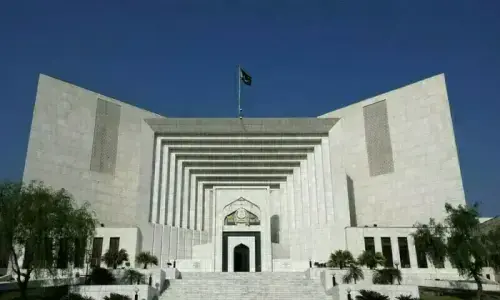
ISLAMABAD: The government has decided to challenge a recent Supreme Court judgement calling for a halt to the practice of engaging private counsel by the federal government. Aggrieved by the directions, the government is claiming that the order virtually impedes the executive from the performance of its functions under the law and Constitution.
“The engagement of private counsel by the federal or provincial governments is a matter [that] falls within the policy domain of the government where no interference or prohibition can be issued,” argued the petition seeking a review of the Feb 8 judgement, where Justice Qazi Faez Isa had termed “improper” the government practice of engaging private advocates to plead their cases.
Filed by the Attorney General’s Office on behalf of the federal government, the review petition asks the Supreme Court to consider reviewing observations made in the judgement and allow it to come out with a policy decision with regard to the engagement of private counsel in matters of public importance.
The government had to face embarrassment when, following the judgement, senior lawyer Makhdoom Ali Khan withdrew from two key cases — representing the interior ministry in the Quetta Commission case and the Sindh government in the case regarding the appointment of advisers to the chief minister.
The observations, the petition argued, involved the interpretation of the Constitution and the law, adding that it was obligatory upon the Supreme Court that the attorney general and the advocates general be heard before a decision is made.
Moreover, the petition maintained that the judgement was based on an incorrect interpretation of Articles 100 and 140 of the Constitution and the Central Law Officer’s Ordinance 1970, as well as laws relating to provincial law officers.
The judgement, the petition contended, was against well-settled principles of interpretation with regards to the functioning of the government, i.e. in the absence of an express prohibition contained in the Constitution and the law, the federal government was permitted to do anything it deemed appropriate.
This principle is given in Article 4(2) of the Constitution that “no person shall be prevented from or be hindered in doing that which is not prohibited by law.”
The matter of engagement of private counsel and to be engaged as counsel by the government is a matter which exclusively falls within the domain of the Legal Practitioners and Bar Councils Act 1974. The findings given in the judgement thus militate against Article 18 of the Constitution which provides for the freedom of the business and trade, the petition stated.
It contended that no empirical data was available to the court with regards to the pendency of cases and the law officers and their emoluments, therefore the observations in the judgement were without any factual basis.
The government is a large litigant before the courts of law, the petition maintained, adding that the pendency of cases in the high courts and the Supreme Court shows that if the executive were banned from choosing counsel/advocates, the work of the state would suffer irreparably.
Even previously, the government used to engage private counsel for legal opinion and transactional work, the petition argued, adding that for the emergent work, it may not be beneficial for the governments to hire officers at a large scale as that would be a regular drain on resources.
Thus, the engagement of the private counsel may not be prohibited nor made conditional upon certification by the law officers, the petition stated.
Published in Dawn, February 15th, 2017