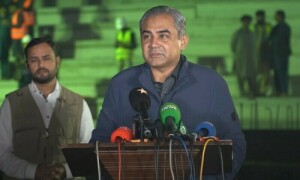
Shahbaz Taseer, the son of slain Punjab Governor Salmaan Taseer, while giving an interview to DawnNews on Wednesday, said no security or intelligence agency came to his rescue during captivity, and “it is Allah’s blessing” that he managed to escape.
Months after the assassination of his flamboyant father over siding with a blasphemy convict, Shahbaz Taseer was abducted from Lahore on Aug 25, 2011 by the Islamic Movement of Uzbekistan (IMU) when he was on his way to his office. He was recovered in March this year after being held captive for almost five years.
Politicians abandoned Taseer family
Talking about the role of Pakistan Peoples Party after the death of his father, Shahbaz said: “In order to correct the record I must mention that after the assassination of my father, Bilawal was the only person who contacted me.”
Every other senior politician had distanced themselves from the Taseer family, saying it was a controversial issue, he added.
'No deal behind my release'
“I have only Allah to thank for my freedom, as no one else played any part in my release, neither the security agencies nor the government authorities,” he said.
“The security agencies were only involved in bringing me back from that hotel in Kuchlak near Quetta, where I reached after running away from my captors.”
When asked whether any deal was struck with the captors to ensure his release, Shahbaz categorically negated the notion saying, “The only deal was that I managed to escape from captivity.”
He was of the view that freedom is a wonderful gift of life which people generally take for granted, and that he was glad to have it back.
"My story is a story of survival, it’s a story of hope. Being hopeless was not an option for me," he asserted.
'Writing a book is a difficult task'
When asked whether he plans to write about his ordeal, Shahbaz said: “Writing a book is a difficult task, it will probably take me a year to write it down. It’s a challenge for me.”
“I feel lucky that my grandfather was a poet and father an author.”
Recalling his experiences in captivity, Shahbaz said: “When I look back, there is nothing painful. I see it as a healing experience.”
“For four years I never spoke to anyone, I had very little exposure to humans.”
“I also learnt Pashto during captivity, it’s a difficult language and it took me nearly three years to learn basic sentences in order to communicate with my captors — as they only spoke Pashto and Uzbek,” he said.
"Initially they were very frustrated that I could not understand their language. That was a hard time for me, I tried a lot to talk to my captors but they started abusing and torturing me."
Shahbaz said it was difficult for him to make a human connection with the persons who used to torture him.
When asked to share any particular instance he plans to write about, Shahbaz recalled: “Once there was a drone strike on the hideout where militants had kept me, I got injured in it too. My captor had no other place to hide me. So he took me to his home. His one-and-a-half-year-old son came to the room in which I was kept and started playing with his toys.
"That brought a smile to my face. At that point I realised that I had not smiled for more than two years. These are the instances I plan to write about,” he said.
Nearly five years in captivity
Shahbaz was kidnapped from Lahore in August 2011, near his company’s head office in the Gulberg area. He was driving towards the offices of the First Capital Group, off M.M. Alam Road in Gulberg when he was intercepted by the kidnappers.
The Pakistani Taliban never officially confirmed their involvement in the kidnapping, but there were reports that the army operation in the tribal areas had made it difficult for the group to keep him.