ALEPPO: Syria’s rebels lost all of the northern neighbourhoods of their stronghold in east Aleppo on Monday, as the army made significant advances in its offensive to recapture the entire city.
The regime gains have prompted an exodus of thousands of desperate civilians, some fleeing to districts held by the government or Kurdish forces, others heading south into areas still under opposition control.
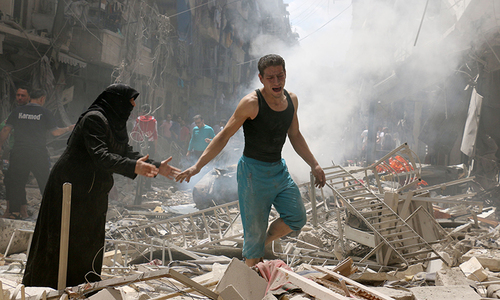
“The situation is disastrous,” said Ibrahim Abu Al-Leith, a spokesman for the White Helmets rescue group in the Ansari neighbourhood. “People are sleeping in the streets. They don’t have anything to eat or drink, but neither do we,” he said.
The loss of eastern Aleppo would be a potentially devastating blow to Syria’s rebels, who seized the area in 2012.
The opposition has steadily lost territory since Russia began an intervention to bolster President Bashar al-Assad in September 2015.
On Monday, government forces seized the Sakhur, Haydariya and Sheikh Khodr districts, and Kurdish fighters took the Sheikh Fares neighbourhood from rebels, the Syrian Observatory for Human Rights monitor said.
“This is their [the rebels’] worst defeat since they seized half the city in 2012,” said Observatory director Rami Abdel Rahman.
The advances left all of north-east Aleppo under government control.
Cold, hungry civilians
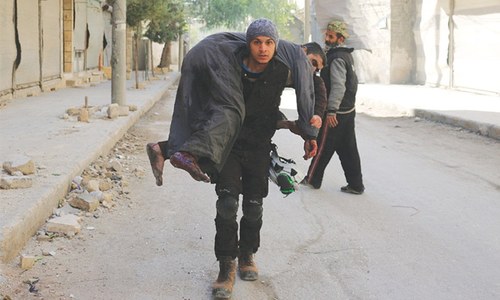
Syria’s White Helmets warned on Monday they had no more fuel reserves for vehicles they use to rescue civilians after bombardment.
In a video statement, the rescue group urged on “all humanitarian, aid, and medical organisations to immediately intervene to put an end to the humanitarian disaster” facing civilians in besieged Aleppo.
Nearly 10,000 civilians have fled the east, the Observatory said, with about 6,000 moving to the Kurdish-held Sheikh Maqsud neighbourhood and 4,000 to government-held west Aleppo.
Hundreds of civilians were also fleeing south to the remaining rebel-held districts with little more than the clothes they wore, an AFP correspondent said.
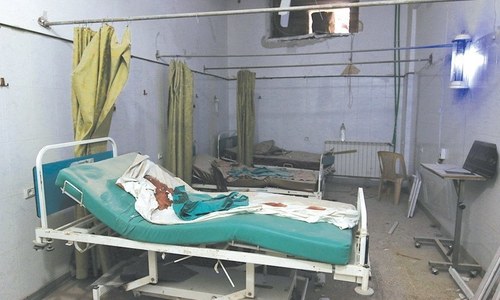
The United Nations said it was “deeply concerned” about the plight of civilians in the east, where international aid is exhausted and food stocks are desperately low after more than four months of siege. The UN has appealed for access to the east many times, but has failed to secure the necessary guarantees to enable aid deliveries.
‘Turning point’ in war
The government advances mean the regime now controls at least a third of eastern Aleppo, just under two weeks into its renewed bid to recapture the city.
State television said the army had captured the key Suleiman al-Halabi water pumping station, which controls supply to government-held west Aleppo and has periodically been shut by rebels.
Three people were killed and another 29 wounded in rebel fire on western Aleppo on Monday, state media said. And regime bombardment of the eastern districts killed six civilians, Abdel Rahman said.
The assault has been waged with heavy air strikes, barrel bomb attacks and artillery fire that have killed at least 235 civilians, including 27 children, in east Aleppo, according to the Observatory.
Rebel fire into the government-held west has also killed at least 27 civilians, among them 11 children, since November 15, the monitor says.
Syria’s Al-Watan daily, which is close to the government, said the next stage of the operation would be “to divide the remaining [rebel-held] area into ... districts that will be easily controlled and to capture them successively”.
Fabrice Balanche, a Syria expert at the Washington Institute for Near East Policy, said the regime retaking east Aleppo “would be a turning point” as it would then hold “the five largest cities in Syria” including the capital. Syria’s deputy foreign minister on Monday denounced accusations by “western” countries that it has used chemical weapons in the conflict as “a campaign of lies”. Faisal Muqdad was speaking at the annual conference in The Hague of countries belonging to the Chemical Weapons Convention.
Published in Dawn November 29th, 2016