0
0

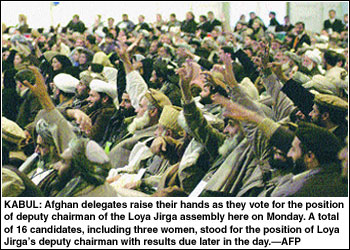 KABUL, Dec 15: Afghanistan’s grand assembly began a landmark debate on the drafting of the country’s fledgling constitution on Monday amid sharp differences over the strong presidential system outlined in the current draft document.
“The present constitution is not for future, it is for continuation of this government,” Abdul Hafiz Mansour, an elected delegate for Kabul province, said in a speech on Sunday after the tribal assembly, known as the loya jirga, was opened by former king Mohammad Zahir Shah.
Moderate mujahideen leader Sibghatullah Mujaddidi, one of 50 delegates appointed by the president, was later elected chairman.
Monday’s session was dominated by the vote for the deputy chairmen, with Counter Narcotics Department director Mirwais Yasini winning the post of first deputy. A total of 16 candidates, including three women, stood for the positions, with women’s delegate Safia Siddiqi taking one of the four posts eventually settled on.
Several candidates used their speeches to complain about problems in their provinces until Finance Minister Ashraf Ghani asked them to stop.
“I humbly request that you concentrate on the constitution rather than other issues,” he said, adding he was conveying the message on behalf of President Hamid Karzai. Local problems could be tackled after the loya jirga, he said.
Besides Ashraf Ghani, Vice President Karim Khalili, Foreign Minister Abdullah Abdullah and Interior Minister Ali Ahmad Jalali were among the ministers sitting in on Monday’s session, which they are allowed to attend but not take part in.
US ambassador Zalmay Khalilzad, who is an Afghan-American, also looked in.
With Monday’s session dominated by the voting and procedural matters, delegates to the loya jirga are due to start discussions on Tuesday on controversial key issues, eg the balance of power between the central government and provinces and the power of the president.
They will also determine the delicate question of how large a role Islam will play in the new constitution, the role of women and human rights.
The European Union, fresh from its own failure to agree on a first-ever constitution, expressed its “sincerest wishes” that Afghanistan could agree on a new constitution.
Debate has already raged over the draft, with critics warning it risks widening the country’s deep ethnic and factional divides.
The current draft, which outlines a presidential system under Islamic laws, does not detail how power would be distributed either within the central government or between Kabul and the provinces.
Former monarch Zahir Shah told delegates they “have full rights to make amendments and bring changes” to the draft.
President Karzai on Sunday repeated his insistence that Afghanistan needed a presidential rather than parliamentary system.
On the eve of the convention, he expressed confidence the constitution would be ratified by delegates, shrugging off the threat of disputes between disparate factions among them.
“I don’t see any possibility of deadlock,” he said.
Over the past century Afghanistan has been an absolute monarchy, constitutional monarchy, republic, Soviet dictatorship and was ruled by the hardline Taliban, but it has yet to taste democracy.
Powerful factions, international analysts and rights groups say the new constitution, which will set in motion democratic elections scheduled for June, threatens to alienate ethnic groups and fails to evenly distribute power.
Streets around the meeting place have been sealed off with US troops, international peacekeepers, Afghan soldiers, police and secret service agents providing heavy layers of security amid threats from militants loyal to the Taliban. —AFP