Sikhs unburden themselves at Guru Nanak’s birthplace


 49
49


While sermons at the 547th birth anniversary celebration of Guru Nanak at Gurdwara Janamsthan Nankana Sahib asked people to reflect and ensure kindness under any circumstances, creation of Khalistan, a separate homeland for Sikhs, remained the main topic of discussion among the Sikh representatives.
Thousands of Sikh pilgrims from the United Kingdom, the United States, Canada, Malaysia, Iran and Kenya seemed overwhelmed by the prospect of visiting Nankana — the birthplace of Sikhism’s founding father.
Inside the Gurdwara, most people from the older generation were busy listening to Sikh representatives. One after the other, the speakers, largely belonging to Pakistan’s Sikh Gurdwara Prabandhak Committee, spoke of injustices against the Sikhs, human rights violations and the increasing drug menace in India’s Punjab state.
Others went on an anti-India vitriol, but at the same time called upon the Pakistani authorities to set up more Gurdwaras for the 20,000-strong Sikh community living in this country. Banners near the pilgrims’ sleeping quarters reminded them about the riots and killings of Sikhs that rocked India in 1984.
Even before the celebrations began on Monday, there was talk at the Gurdwara for the inclusion of two issues in the religious sermons. One relates to the water dispute between the Indian states of Punjab and Haryana and the other to the cancellation of a meeting of Sikh religious representatives that was to be held in both Pakistan and India on Nov 10. It was cancelled after some delegates were arrested in Amritsar. They intended to discuss the Sikh freedom movement and the increasing trend of suicide among farmers in East Punjab and other Indian states.
“These problems faced by our community in India won’t go away until we do something about it. We need to separate if we want to remain relevant,” said a member of the Gurdwara committee, Gopal Singh Chawla.
As majority of pilgrims listening to him remained hesitant and didn’t seem as emotional when he raised slogans of a separate homeland for Sikhs in India, Chawla decided to announce his resignation from the post and left the podium amid blank stares.
Parminder Kaur, 76, a national of the United Kingdom, is visiting Pakistan for the second time to attend the birth anniversary of Guru Nanak at Gurdwara Janamsthan. Sitting at the back in the same veranda, she shakes her head from time to time. “What’s the point of using a religious platform for your own political aims?”
Armed with pictures of her ancestral home in Faisalabad Chak 106, she says that there is “no need to listen to those who don’t have to face the consequences of their speech. Vulnerable communities in both countries continue to face trouble because of well-timed speeches”.
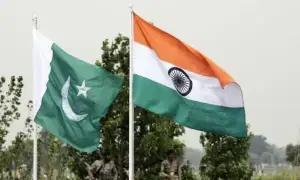
With tensions rising between India and Pakistan, this year the number of pilgrims coming from India is fewer than last year, says Joga Singh, a representative of the Pakistan Gurdwara Prabandhak Committee in Britain .
“There’s been a considerable difference due to tensions. There are always other reasons. For instance, people still use passport of their place of birth while being a UK national. And their visas get rejected as a result of it. But the absence of direct flights from India and a general fear of being mistreated kept people away this time around,” he added.
Joga Singh himself has not been to India since leaving for Britain in 1981. In addition, his constant campaigning for a separate Sikh homeland ensured that he never gets an Indian visa. “This is how it is everywhere in the world. People like me have to look for places where we can speak our mind. The world is quite similar that way,” he added.
A mile away from the Gurdwara, at the sleeping quarters meant for Indian Sikhs coming from the UK, Canada and the US, Manmohan Singh Johal, said Pakistan was his home.
“I don’t care what is said at the event. I heard these people give the same speech every year. It depends on us what we want. I told my children back in the UK that I will visit Pakistan for Baba’s jayanti (birthday) this time. This makes it my first visit to Pakistan in about 40 years,” he added calmly.
Johal’s father, a resident of Faisalabad’s Chak 101, left Pakistan for Jalandhar, India, in 1947. Later he left India for the UK during the 1960s in search of a job and stayed there.
“There’s so much fear-mongering on both sides, especially the media, that one feels overwhelmed. For the first time in years, I took a round of Lahore’s inner city on a whim on Saturday. I cried later. There’s so much I missed all these years,” he said as hymns echoed from the main hall of the Gurdwara.
Published in Dawn, November 15th, 2016