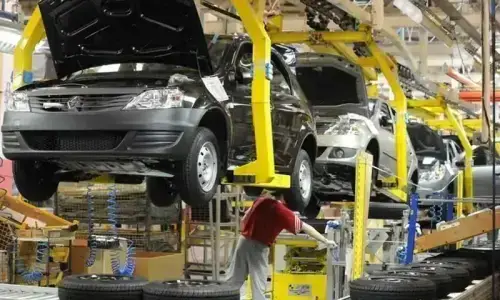
AFTER three decades of dramatic growth, China’s manufacturing engine has largely stalled. With rising salaries, labour unrest, environmental devastation, and intellectual property theft, China is no longer an attractive place for Western companies to move their manufacturing to. Technology has also eliminated the labour cost advantage, so companies are looking for ways to bring their high-value manufacturing back to the US and Europe.
China is well aware that it has lost its advantage, and its leaders want to use the same technologies that have levelled the playing field to give the country a new strategic edge. In May 2015, China launched a 10-year plan, called Made in China 2025, to modernise its factories with advanced manufacturing technologies, such as robotics, 3D printing and the Industrial Internet.
And then, in July 2015, it launched another national plan, called Internet Plus, “to integrate mobile Internet, cloud computing, big data and the Internet of Things with modern manufacturing”.
China has made this a national priority and is making massive investments. Just one province, Guangdong, committed to spending $150 billion to equip its factories with industrial robots and create two centres dedicated to advanced automation. But no matter how much money it spends, China simply can’t win with next-generation manufacturing. It built its dominance in manufacturing by offering massive subsidies, cheap labour, and lax regulations. With technologies such as robotics and 3D printing, it has no edge.
After all, American robots work as hard as Chinese robots. And they also don’t complain or join labour unions. They all consume the same electricity and do exactly what they are told. It doesn’t make economic sense for American industry to ship raw materials and electronics components across the globe to have Chinese robots assemble them into finished goods that are then shipped back. That manufacturing could be done locally for almost the same cost. And with shipping eliminated, what once took weeks could be done in days and we could reduce pollution at the same time.
Most Chinese robots are also not made in China. An analysis by Dieter Ernst of the East-West Centre showed that 75 percent of all robots used in China are purchased from foreign firms (some with assembly lines in China), and China remains heavily dependent on the import of core components from Japan. By Ernst’s count, there are 107 Chinese companies producing robots but many have low quality and safety and design standards. He anticipates that fewer than half of them will survive.
The bigger problem for China is its workforce. Even though China is graduating far more than one million engineers every year, the quality of their education is so poor that they are not employable in technical professions. This was documented by my research teams at Duke and Harvard. Western companies already have great difficulty in recruiting technical talent in China.
Bloomberg-The Washington Post Service
Published in Dawn, August 28th, 2016