0
0

ISLAMABAD, Nov 29: Wapda has sought the prime minister’s intervention with regard to a ruling of the Central Board of Revenue extending application of general sales tax law to the Federally Administered Tribal Areas and Provincially Administered Tribal Areas.
The CBR earlier this month ruled that GST on electricity bills was also applicable on Fata and Pata consumers. The CBR informed Wapda and the power ministry that the temporary deferment of Sales Tax Act 1990 in the Fata and Pata had been withdrawn and the provisions of sales tax act have been reinforced in the tribal areas.
Sources at the power ministry confirmed that Wapda had sought guidance from the federal government as to what should it do as the CBR ruling was now binding.
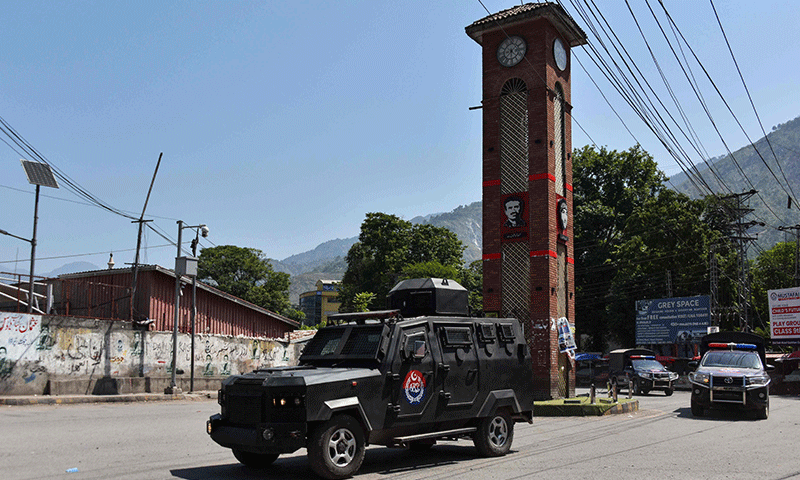
The sources said the CBR had created a difficult situation because of the presence of the armed forces in the tribal belt owing to anti-Taliban operation.
A Wapda official told Dawn that the Authority was left with no option but to collect GST from the tribal consumers under the CBR ruling and that was why it had sought the prime minister’s intervention and guidance into the matter.
“Wapda has been unable so far to collect its own revenue from the tribal consumers due to stiff resistance from the tribal people to pay metered electricity bills,” he said.
The official said that Wapda’s total billing to the tribal areas stood slightly lower than Rs10 billion per year, of which total collection ranged between one and two per cent. This means that total bill collection amounts to about Rs100-200 million per annum.
Under the Wapda-CBR arrangement, Wapda has to pay 15 per cent GST on total electricity bills recovered. As such, total CBR revenue on account of GST on electricity to the tribal areas amounted to Rs15-30 million, he said.
Thus consumers in Fata/Pata have to pay GST on power consumption as applicable elsewhere in the country under the CBR ruling.
The CBR and Wapda were divided over the applicability of Sales Tax Act 1990 in the Fata and Pata as Wapda contended that sales tax could not be charged through bills issued to the electricity consumers of Fata and Pata.
It quoted article 247 (3) of the constitution which read: “No act of Majlis-e-Shoora (parliament) shall apply to any Federally Administered Tribal Area or to any part thereof, unless the President so directs, and no act of Majlis-e-Shoora (parliament) or a provincial assembly shall apply to a Provincially Administered Tribal Area, or to any part thereof, unless the Governor of the province in which the tribal area is situated, with the approval of the President, so directs; and in giving such a direction with respect to any law, the President or, as the case may be, the Governor,
CBR, Wapda in row over tax on Fata power bills may direct that the law shall, in its application to a tribal area, or to a specified part thereof, have effect subject to such exceptions and modifications as may be specified in the direction.”
Wapda has said that according to opinion of its legal experts, the constitutional as well as legal provisions of Sales Tax Act 1990 do not oblige Wapda to collect sales tax through electricity bills in the Fata and Pata.
The tax authorities, however, opined that GST was leviable, irrespective of the fact that such supplies were made to persons residing in areas to which Sales Tax Act 1990 had not been extended.
According to the CBR interpretation, any product produced and sold from the country, except for export purposes, was liable to GST and was not ready to accept tribal areas as a separate entity because power was produced and sold from inside the country.
However, on a clarification sought by Wapda, the CBR said that chargeability-wise, levy of sales tax was irrespective of the fact that such supplies were made to persons residing in areas to which sales tax act had not been extended.
In the presence of the CBR’s ruling, Wapda on its own cannot withdraw imposition of GST on electricity bills being issued to consumers in the tribal areas. Resultantly, the temporary deferment regarding invocation of the provisions of Sales Tax Act 1990 in the tribal areas will now be enforced.