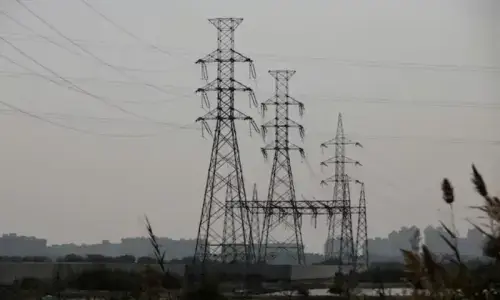
PESHAWAR: About 250 mini and micro hydropower projects (MHPs) will become fully operational and functional to provide electricity to around 245,000 people in hilly areas of Khyber Pakhtunkhwa through community-based local institutional mechanisms by the end of 2016.
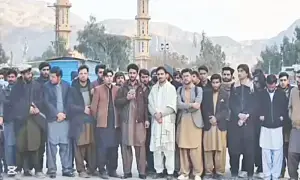
This was announced by heads of various NGOs/firms working on the construction of MHPs while speaking at a joint press conference at Peshawar Press Club on Sunday. The contractors headed by chief executive officer of Hydrolink Engineering and Equipment Company (pvt) limited Fazal Rabbi included Fatma Welfare Foundation CEO Farhad Khan and Dir Area Development Organisation’s Mohammad Khaliq.
Speaking about his work experience with communities, Mr Rabbi said that people living in the remote localities in Chitral, Dir and Battagram districts had welcomed launching of the MHPs as they did not have power supply since inception of the country. He said that though power supply lines passed through different localities, some villages in these districts were not given electricity for unknown reasons.
Appreciating the Khyber Pakhtunkhwa government, Mr Rabbi said that the hydropower projects would help tap the water potential and enable people to get electricity on low cost to increase their income. Besides the people’s dependence o fuel (kerosene) would be reduced and they would be encouraged to protect their forests.
Contractors say over 200,000 people will benefit from the projects
He said that the hydropower projects were useful for the local people as these would provide low cost electricity from Rs2 to Rs4 per unit to the local community.
“We, being the implementer, are confident that by the end of 2016 about 250 MHPs will become fully operational and functional to provide electricity to some 245,000 mountain people through community-based local institutional mechanisms,” he said.
Mr Rabbi said that the NGOs/construction firms were working with the Pakhtunkhwa Energy Development Organisation (Pedo) under close supervision of the Energy and Power (E&P) Department of Khyber Pakhtunkhwa since 2014. He said that the 356 MHPs were purely government-funded community empowerment and participatory projects working successfully.
“We have so far found Pedo’s new management and E&P Department committed to reforming and transforming the organisation into a self-sustainable institution that will not only fulfil the provincial energy demands, but also contribute to the national energy security,” he claimed.
Farhad Khan claimed that Pedo was being run transparently and license was given during two weeks of application and feasibility submitted within six months. He said that progress on 356 MHPs had suffered due to some initial challenges, but now the overall progress and quality of work had no precedent. The projects are regularly monitored by Pedo, E&P Department and provincial monitoring and evaluation directorate.
Published in Dawn, June 27th, 2016