0
0
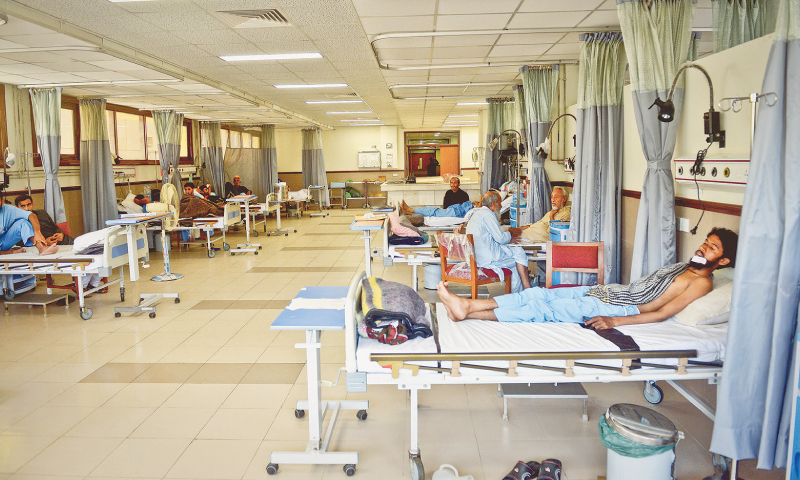

KARACHI: A much-needed medical facility that has already been delayed for a decade because of slow-paced construction and repeated changes in design, the trauma centre at the Civil Hospital Karachi (CHK) will likely take a few months more to become fully operational, it emerged during a recent visit to the centre.
Built at a cost of Rs6 billion against its initial cost of Rs1.2bn, the centre was officially inaugurated last year and was expected to become operational by March this year.
Presently, final touches are being given to some of the floors of the 15-storey building while a process has been started to test the viability of the building infrastructure.
“It’s a large facility with 500 beds and 18 operation theatres and will be made operational in phases. In the first stage, we have transferred 28 patients from a surgical ward of the hospital here to see the response of its mechanical systems,” said Dr Aamir Raza, deputy medical superintendent of Shaheed Mohtarma Benazir Bhutto Trauma Centre.
According to him, the staff has so far encountered minor problems since patient treatment started at the centre 15 days ago. But the major challenge was to begin surgical procedures, he addded.
“Our target is to transfer the entire neurosurgery department and ward into the centre within 10 to 15 days. Later, we will be taking up the challenge to start offering emergency services, probably after Ramazan,” he observed.
Currently, no dedicated facility to treat trauma cases is available in the public sector in the city and in case of a disaster patients are often rushed to the Jinnah Postgraduate Medical Centre (JMPC) as it offers better emergency services. The CHK emergency section, however, is in a pitiable state, lacking sufficient space and quality service.
“At the centre, the patients will have all state-of-the-art medical services under one roof. There will be units for cardiothoracic, oral and maxillofacial and eye surgeries as well as for critical burn cases,” he said.
But a major highlight of the centre, in his opinion, would be to offer vascular surgery, a highly specialized area and a service no longer available at the CHK after the concerned faculty member left the hospital three to four years ago, he said.
“We had only one vascular surgeon and he left for greener pastures. So, at the centre, we aim to start this service and have hired a young vascular surgeon,” he said.
Regarding its infrastructure, Dr Raza said the centre with centralized air conditioning system would be generating electricity on its own from the steam released by its chillers. The K-Electric and generators would act as backups.
“Out of a total of 160 people who have been recruited so far, 100 individuals have joined. The centre will be run by a five-member board consisting of Dr Saeed Qureshi, social activist Faisal Edhi, Abdullalh Feroz (representing a pharmaceutical company), Prof Khalid Mahmood and a government official, Shaista Mubarak,” he said.
To a question, he said though the threat of losing trained staff would always loom, the centre was offering market-based salary to its employees.
Published in Dawn, June 13th, 2016