



 0
0

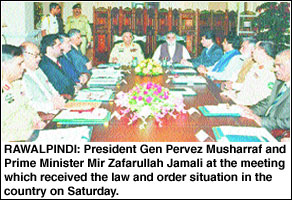 ISLAMABAD, Nov 15: The government on Saturday banned three sectarian and militant organizations and placed another on the watch list under the Anti-Terrorism Act, 1997.
The organizations banned on Saturday were in fact the ones that had already been banned by the government sometime back and they had relaunched their activities under new names.
They are: Islami Tehrik Pakistan (former Tehrik-i-Jafria Pakistan), Millat-i-Islamia Pakistan (former Sipah-i-Sahaba Pakistan), and Khuddam-ul-Islam (former Jaish-i-Mohammad).
The group put on the watch list is Jamaat-ul-Dawa.
The decision was taken at a meeting attended by President Gen Pervez Musharraf, Prime Minister Mir Zafarullah Jamali, provincial governors and chief ministers and the interior minister.
The meeting resolved that strict action would be taken against any one carrying or displaying any kind of arms, and reiterated that no militant or sectarian groups would be allowed to function in the country.
Mass gatherings of religious parties would be regulated as a licence, to be issued by the administration, would be required for holding any such gathering.
The meeting took stock of the law and order situation with a view to streamlining short, medium and long-term measures for improving the overall environment.
An official announcement quoted the president as having said at the meeting that Pakistan was at the crossroads where, after having reached an “elevated international status and improved economy,” it was poised to march ahead on the path of progress. He stressed the need for improvement in the law and order for the attainment of this objective.
“We have to ensure stability through effective security measures as well as make collective efforts for the promotion of tolerance and harmony in society,” he said.
The prime minister said the government attached importance to good governance in which the maintenance of law and provision of security to the common man was accorded priority. The government was committed to ensuring a sustained, congenial and friendly environment for both local and foreign investment, he added.
Interior Minister Makhdoom Syed Faisal Saleh Hayat briefed the meeting about the state of law and order.
NWFP Governor Syed Iftikhar Hussain Shah informed the meeting about the measures taken for maintenance of security in tribal areas. He also briefed it about the pace of development activities undertaken to bring the Federally Administered Tribal Areas into the mainstream of national life.
The president and the prime ministers appreciated the progress made in the implementation of the Police Order 2002 and said financial support would be provided to the provinces in this regard.
They also welcomed the efforts the provincial governments were making to generate their own resources for sustained implementation of the Police Order.





























