3
3

WASHINGTON: Pakistan views India’s cold start doctrine as a real threat to its security and is unwilling to give up the defensive mechanism it has built to counter this threat, officials and experts said.
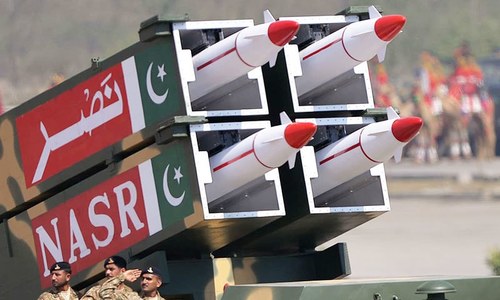
India’s cold start doctrine, and the tactical weapons that Pakistan has made to counter this threat, drew international attention when US President Barack Obama mentioned them at his news conference last week.
On the conclusion of the Nuclear Security Summit in Washington on April 1, President Obama urged both India and Pakistan to stop moving in the wrong direction as they develop their military doctrines.
President Obama also expressed concern over a rapid increase in “small tactical nuclear weapons, which could be at greater risk of theft”.
“President Obama indirectly vindicated Pakistani position that cold start exists and it is a move in wrong direction,” said a Pakistani nuclear expert while responding to the US leader’s statement.
The expert agreed that Mr Obama had also noted the existence of tactical nuclear weapons in South Asia but insisted that Pakistan was forced to make those weapons to counter the Indian threat.
Another Pakistani expert explained that the cold start doctrine or the proactive operations strategy, as India now preferred to call it, was not a putative or ‘hypothetical’ theory.
“It’s neither merely a concept nor a myth. It is an operationalised reality that has compelled Pakistan to take suitable deterrence measures,’ the expert added.
Both experts insisted that Pakistan had taken “minimal measures to credibly deter India” across the strategic, operational and tactical spectrum of threat.
“In the doctrine, caveats like ‘even the threat of use of nuclear weapons will invoke a nuclear strike’ indicate that India’s Not First Use policy is just a diplomatic jargon,” one of them said.
Both experts pointed out that India too possessed short-range tactical nuclear weapons like Prahaar and Pragati. Prahaar — with 150km range — was tested two months after Pakistan developed Nasr.
Later, Pragati — with 70km range — was also developed and is exhibited for sale.
“It would be a very dangerous assumption to enact cold start with a hope to dominate escalation and keep such a war limited and under nuclear threshold,” one of the experts warned. “Cold start can lead to hot wars.”
Published in Dawn, April 12th, 2016