26
26


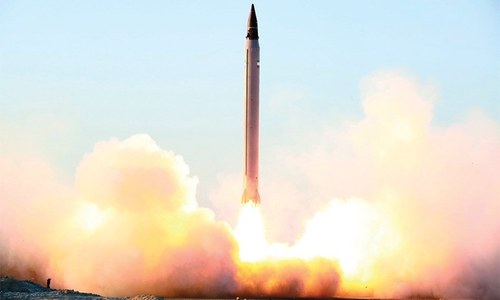
DUBAI: Iran's Islamic Revolutionary Guards Corps (IRGC) test-fired two ballistic missiles on Wednesday morning that it said were designed to be able to hit Israel, defying a threat of new sanctions from the United States (US).

The launches followed the test-firing of several missiles on Tuesday as part of a major military exercise that the IRGC says is intended to "show Iran's deterrent power and... ability to confront any threat".
On Wednesday the IRGC fired two Qadr missiles from northern Iran which hit targets in the southeast of the country 1,400 kms (870 miles) away, Iranian agencies said. The nearest point in Iran is around 1,000 km from Tel Aviv and Jerusalem.

"The reason we designed our missiles with a range of 2000 kilometres is to be able to hit our enemy the Zionist regime from a safe distance," Brigadier General Amir Ali Hajizadeh was quoted as saying by the ISNA agency.
Israeli officials had no immediate response to the Iranian launches, which come as Israel hosts US Vice President Joe Biden for talks on regional issues. Last week, the allies concluded a joint missile defence drill in Israel.
Sanctions threaten the US
State Department said it would raise Tuesday's tests at the United Nations Security Council (UNSC). The speaker of the US House of Representatives also said lawmakers would push for more unilateral sanctions.

Two months ago, Washington imposed sanctions against businesses and individuals linked to Iran's missile programme over a test of the medium-range Emad missile carried out in October 2015.
"The missiles fired today are the results of sanctions. The sanctions helped Iran develop its missile programme," Brigadier General Hossein Salami, deputy commander of the IRGC, was quoted as saying by Fars.
The IRGC, a powerful force that reports directly to the supreme leader, is deeply suspicious of the US and its allies. It maintains dozens of short and medium-range ballistic missiles, the largest stock in the Middle East.
Washington fears those missiles could be used to carry a nuclear warhead at some point in the future, even after Iran implemented a nuclear deal with world powers in January that imposes strict limits and checks on its disputed nuclear programme.
Iran's missile programme is subject to UNSC resolution 2231 that calls on the Islamic Republic not to develop missiles designed to be capable of carrying nuclear warheads. Iran says its missiles are solely a conventional deterrent.
Washington said Tuesday's missile tests would not violate the Iran nuclear deal itself, under which Tehran has won relief from economic sanctions. That deal was also endorsed in resolution 2231.