8
8

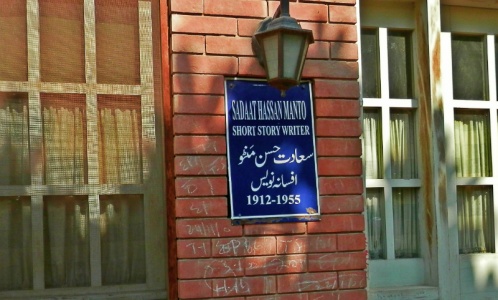
The friendship between renowned writer Sadat Hasan Manto and movie star Shyam began with conversations at a staircase of the High Nest building on Lady Jamshedji Road in Mumbai sometime in the 1940s.
The bond between the two men led to perhaps the most poignant chapter in the book Stars From Another Sky, a translation from Urdu of Manto’s encounters and experiences of the Mumbai film world of the ’40s.
Also read: Literary genius Manto comes to life in much-awaited biopic
The evocative piece, originally called Murli Ki Dhun, chronicles the author’s close association with the actor.

Sundar Shyam Chadha would have been 96 on February 20. He died on April 25, 1951, after falling off a horse on the sets of the Filmistan swashbuckler Shabistan and sustaining head injuries.
Shyam passed away at the peak of his career, and many old-timers are convinced that if he survived, he would have given Dilip Kumar, Dev Anand and Raj Kapoor, the triumvirate of the ’50s, a solid run for their money.
At the time of his demise, Shyam was almost, if not as popular, as the ’50s icons, besides being considered one of the most handsome leading men of Hindi cinema.
Shyam was born in Sialkot and spent his formative years in Rawalpindi, where he studied at Gordon College.
Braving family opposition, in particular from his father, Shyam powered on thanks to the support of his uncle, Tarachand Chadha.
It was at the Bombay Talkies studio that Shyam’s friendship with Manto, who was working there at the time, blossomed.
Or, as Shyam would say, it was "hiptullha."
Writing on this strange term’s origin in Murli Ki Dhun or Shyam: Krishna’s Flute, Manto recalls, "One morning while on the train from my home to Bombay Talkies, I opened the newspaper at the sports page to read the scorecard of a cricket match that had been played at the Brabourne Stadium, when I came across a strange name, Hiptullha. I had never heard such a name before. I assumed, therefore, that it was a corrupt form of ‘Haibatullah’. When I got to the studio, the script conference [for Mahal, 1949] was already in session. In his typical and ornate style, Kamal [Amrohi] was describing one of the episodes. After he was done, Ashok [Kumar] looked at me, ‘Well Manto?’ I don’t know why, but I heard myself saying, ‘It is alright – but it lacks 'hiptullha.' Somehow ‘hiptullha’ managed to convey my meaning. What I wanted to say was the sequence lacked force."
The coinage not only gained acceptance but even inspired variations, such as something lacked "hiptullhity" or needing to be "hiptullised."
At one point, Ashok Kumar needed to know just what the word meant. Manto continues, "Shyam had joined us by then. He began to laugh and his eyes narrowed. When I had seen that odd name in the paper, he was with me on the train. Almost rolling over, he informed the meeting that it was Manto’s latest Mantoism; when all else failed, he dragged ‘hiptullha’ into the film world. Soon the word gained popular currency in Bombay’s film circles."
When Manto decided to make Pakistan his home, it was Shyam who accompanied Manto to the Mumbai port from where he would sail to Karachi.
"There was still time to board the ship," Manto recalls.
"He kept telling funny stories. When the gong was sounded, he shouted ‘Hiptullha!’ one last time and walked down the gangway, taking long, resolute strides. Never even once did he look back."
Must read: ‘Manto didn’t have the heart to stay behind in India’
Shyam was working on two films, Kale Badal, with the "Lara Lappa" actress Meena Shorey, and Shabistan with Naseem Banu, at the time of his demise.
Manto paid a heartfelt tribute to his friend in his writings.
There are descriptions of their boisterous drinking sessions, Shyam’s unsuccessful attempt to flirt with actress Kuldip Kaur in a first-class suburban train compartment, an acknowledgment of a gift of money from Shyam, and hints of dalliances with Nigar Sultana and Ramola, as well as the woman Shyam eventually married, Mumtaz, also known as Taji.
Manto and Shyam remained in touch through sporadic letter writing. Shyam even visited Lahore along with comedian Om Prakash, where he met his old friend.
Take a look: Everyone’s Manto
After the initial euphoria of hugging each other and talking nineteen to the dozen had passed, Manto remembers,
"Shyam was in a strange mental state. He was intensely conscious of his presence in Lahore, the same Lahore whose streets were once witness to his numerous romances. This Lahore was now thousands of miles from Amritsar. And how far was his beloved Rawalpindi where he spent his boyhood? Lahore, Amritsar and Rawalpindi were all where they used to be, but those days were no longer there, nor those nights which Shyam had left behind. The undertaker of politics had buried them deep, only he knew where."
Manto was battling his own demons, and was a patient at a mental hospital in Lahore, when he heard of Shyam’s death in 1951.
Manto writes, "I distinctly remember that when I read about Shyam, I said to the inmate in the room, next to mine, ‘Do you know that a very dear friend of mine has died?"
"Who?" he asked.
"Shyam," I replied in a tearful voice.
"Here? In the lunatic asylum?"
"I did not answer his question. Suddenly, one after another, several images sprang to life in my fevered brain: Shyam smiling, Shyam laughing, Shyam screaming, Shyam full of life, utterly unaware of death and its terrors. So I said to myself that whatever I had read in the newspaper was untrue… even the newspaper I held in my hand was only a figment of my imagination."
Shyam’s wife was pregnant with their son, Shakhir, when he died. She migrated to Pakistan after his death. His daughter, Sahira, had a successful run as a television actor.
There is no record of whether Manto met them in Pakistan, but he ends his tribute with a dialogue with Shyam’s spirit:
"Dear Shyam, I left Bombay Talkies. Can’t Pandit Nehru leave Kashmir? Now isn’t that hiptullha?"
This article was originally published on Scroll.in and has been reproduced with permission.