0
0
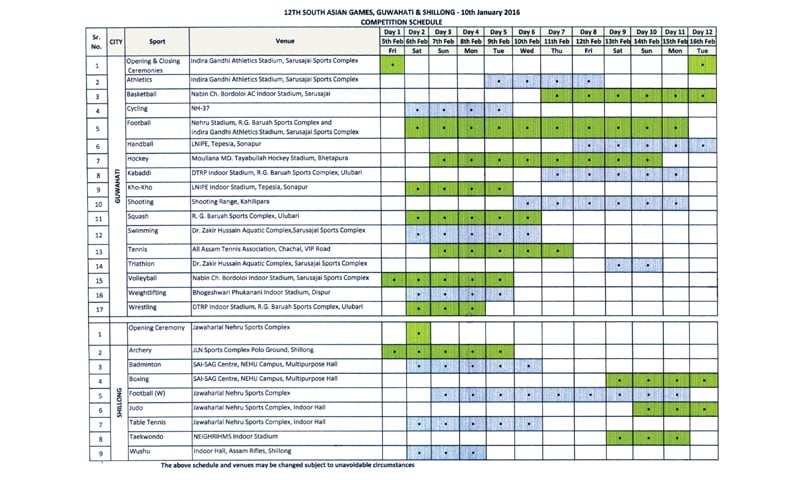

The stage is set for the 12th South Asian Games which are being held in the Indian cities of Guwahati and Shillong from Feb 5 to 16. It has been six years since the last games took place at Dhaka in 2010.
The opening ceremony of the spectacle will be held at Guwahati on Friday.
Designed on the pattern of South East Association (SEA) Games which is participated by member countries of the Association of South East Asian Nations (ASEAN), the SA Games will provide a rare opportunity to the athletes of Asian countries to rub shoulders besides promoting friendship and bridging the gap.
Afghanistan was inducted into the South Asian Association for Regional Co-operation (SAARC) in 2007 raising the strength of members from seven to eight.
The seven founding members are India, Pakistan, Sri Lanka, Bangladesh, Nepal, Bhutan and Maldives.
The inaugural South Asian games were held in five disciplines – athletics, boxing, football, swimming and weightlifting – at Khatmandu in 1984.
Pakistan donated the trophy for weightlifting, India (athletics), Bangladesh (football), Sri Lanka (swimming) and Nepal (boxing).
A 16-member Pakistan squad participated in three disciplines – athletics, boxing and weightlifting and finished third on the medals table with five golds, three silvers and two bronze.
Barring exceptions, the games used to be a two-horse race between India and Pakistan on most occasions. India has maintained their supremacy since inception of the games.
Bhutan, which was supposed to organise the games in Oct 2012, expressed its inability and India offered to hosts the spectacle in Feb 2013.
However, the games suffered a major jolt when the International Olympic Committee (IOC) suspended Indian Olympic Association on Dec 4, 2012, for breach of IOC Charter. The ban was revoked on Feb 11, 2014.
This time the games are being held in 23 disciplines – 16 to be held at Guwahati and seven at Shillong.
According to reports, India is spending Rs700 million in staging the spectacle. Reports say the cost may further escalate due to extra security measures.
It is pertinent to mention that this will be the third time India will play host to the games, the previous two occasions being at Calcutta in 1987 and at Chennai in 1995.
Pakistan has announced to feature in 20 disciplines of the games despite the lack of preparation on their part. And since there will be no Naseem Hameed in athletics this time, there is not much hope for a medal.
The Karachi-based sprinter had done the country proud by becoming Fastest Woman of the South Asia at Dhaka after winning 100m short sprint in 11.81 seconds. The athlete, who first trained at the Athletic Fitness School under honorary coach and veteran international hurdler Mohammad Talib, commemorates sixth anniversary of her success three days from now on Feb 8.
Pakistan’s 416-member contingent that also includes officials and joyriders, will fly to the two Indian cities in batches. The selection of some teams including that of kho-kho and women’s boxing has raised quite a few eyebrows.
The Pakistan Sports Board (PSB) has also raised objection on kho-kho and the official list does not include the discipline.
Meanwhile, a spokesman for the Pakistan Boxing Federation (PBF) said three women boxers were picked by the PBF secretary Iqbal Hussain on his own besides nominating himself as manager.
He further alleged that the girls are not boxers and belonged to wushu and kick boxing.
Pakistan returned with a haul of 19-25-35 medals from the last games. Besides Naseem Hameed, Mohsin Ali (110 m hurdler), Zafar Iqbal (triple jump), Basharat Ali (discus throw) clinched gold in track and field.
Pakistan fetched two golds – team and individual – in squash in addition to hockey gold among others.
Meanwhile, mystery still shrouds as to who will carry the Pakistan flag during the march past at the opening ceremony. Tennis ace Aisamul Haq is the best choice for the job.
Pakistan’s medal tally at a glance:
1st 1984 Kathmandu 5 3 2 (third)
2nd 1985 Dhaka 21 26 12 (second)
3rd 1987 Calcutta 16 36 14 (second)
4th 1989 Islamabad 42 30 22 (second)
5th 1991 Colombo 28 32 25 (third)
6th 1993 Dhaka 23 22 20 (second)
7th 1995 Chennai 10 33 36 (third)
8th 1999 Kathmandu 10 36 30 (fourth)
9th 2004 Islamabad 38 55 51 (second)
10th 2006 Colombo 22 22 32 (second)
11th 2010 Dhaka 19 25 35 (second)
Published in Dawn, February 5th, 2016