15
15

KARACHI: Stakeholders of the textile sector — including bedwear exporters, apparel makers and towel manufacturers — have accused the government of being apathetic to a key economic segment, and also held it responsible for floundering textile exports.
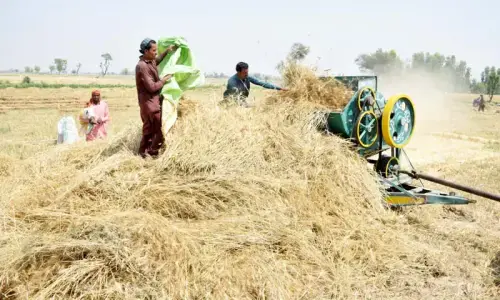
They were particularly frustrated over the outcome of a last week meeting in Islamabad between the Ministry of Textiles and representatives of growers and the textile sector to discuss a strategy to deal with the current year’s cotton crop failure.
Some suggestions were tabled but the secretary did not take a decision in absence of a textile minister, whose slot has been vacant for several months.
Some of the participants suggested that the government should fix minimum support price for cotton, but it was immediately rejected by others on the ground that it would distort the open market policy and create a huge liability for the government in case prices go below support price.
It was also suggested that like India, Pakistan should directly purchase phutti (seed cotton) from growers and after ginning sell the same to industry. But it was rejected because of weak institutions vulnerable to corruption, a participant told Dawn.
The only proposal that generated interest was possibility of giving direct subsidy to small growers. It was suggested that the government should lower power rates for growers and also give fertiliser, pesticide and seeds on subsidised rates. A representative of big growers from Sindh demanded that incentives need to be size insensitive and all growers irrespective of the farm size should be covered.
Shabir Ahmed, patron-in-chief of the Pakistan Bedwear Exporters Association (PBEA), said the issue of cotton crop falls in the domain of the Ministry of Agriculture, and held the ministries of commerce and textiles responsible for falling textile exports.
Pakistan Apparel Forum (PAF) Chairman Jawed Bilwani said benefits of preferential market access to the European Union under GSP+ scheme could not be achieved due to government’s misplaced policies. He said that while Pakistan’s exports during the July-December FY16 fell by 14.5 per cent, Bangladesh’s exports increased by 8 per cent.
Criticising the government for the lack of interest in issues confronting textiles, Towel Manufacturers’ Association (TMA) Chairman Farrukh Maqbool said exports could not increase as long as refunds towards duty drawback, sales tax, and drawback on local taxes and levies (DLTL) remained unpaid.
“Exporters are paying a mark-up of Rs20 billion a year on the working capital they took from banks,” he said.
Aptma Chairman Tariq Saud said the government should immediately come up with a revival package for the textile industry to save the country’s exports and millions of jobs.
Representatives from the Karachi Cotton Association, the Trading Corporation of Pakistan, the Pakistan Cotton Ginners Association, growers’ bodies and government-run research institutes were present in the meeting.
Published in Dawn, January 26th, 2015