After several days of telephonic ping-pong, Adnan Khawaja, the founder of a tech start-up called Ideacentricity, and I finally met at Liberty Chowk in Lahore.
Adnan was promoting his idea of alternative income for rickshaw drivers — a bright, three-by-four-feet ad space at the back of the rickshaw — an opportunity for drivers to generate up to 15,000 rupees of additional, monthly income or even more.

The new hoarding is an improvement on the reflective flex signboard that didn't quite stand out in Lahore’s metropolis of over 8 million people, and consequently failed to attract advertisers. The backlit board, however, is not something one can miss.
Over the next three hours, Adnan and I followed a fleet of 15 rickshaws in his car. As we circled the heart of Gulberg, driving up and down the bustling Main Boulevard and M.M. Alam Road, Adnan re-routed all call-centre queries to his own phone and spoke to interested rickshaw drivers and advertisers.
At various intervals, Adnan also had to fob off local government machinery, looking to make a quick buck. Somehow, while he did all this, he also managed to talk about the inspiration behind Ideacentricity.
"In 2012, I was working with a tech company, heading strategy. One day, while en route to work, I got into an accident that crumpled up my car but luckily left me in one piece. In the immediate aftermath of the accident, I felt safer in a rickshaw than behind the steering wheel."
It was not like Adnan hadn’t sat in a rickshaw before, but in 2012 when he started using rickshaws everyday, he started conversing with rickshaw drivers and soon realised how unpredictable their income was — very much like their lives.
Essentially, wavering income for rickshaw drivers translated to a variety of predicaments, including deferred payments to meet basic expenses, like treating a chronic illness or not affording to pay for their children's schooling.
The stress of not being able to meet basic expenses often resulted in ruthless competition between rickshaw drivers on the streets, which included the ills of cartel control, and restricted access to new entrants in a traditional marketplace.
When Adnan realised all this, he started gleaning lessons from his professional experience in the mobile network industry and deliberated about ways to reduce uncertainty in low-income groups. He subsequently quit his day job to explore plausible business solutions.
In the days ahead, his journey was anything but straightforward. To begin with, Adnan’s father, who was already an established entrepreneur, remained skeptical about his son’s plan to ‘rescue’ rickshaw drivers. His persistent solicitation to ‘consider other business ideas’ gnawed at Adnan’s confidence. And very much like the start, the rest of Adnan’s journey was like a mixed whirlpool of validations and disapprovals.
Luckily for Adnan, he found a business ally in his wife, Hina, who readily became the co-founder of Ideacentricity. As a former Cherry-Blair fellow, she was already ideologically aligned with her husband.
Today, Adnan likes to think of her as the ‘warrior’ in the team; the relentless task master who keeps the engine running. And he considers himself the balancing ‘visionary’ — someone who is rigid on the destination but flexible on the journey.
Inspired by the utility of oDesk (now Upwork) and deeply concerned about the lives of rickshaw drivers, Adnan and Hina introduced an SMS-based platform in June 2013, that connect low income workers, including rickshaw drivers, employers and passengers in their vicinity. The couple called their technology platform 'Odd Jobber'.
Adnan’s goal was to make his technology accessible to the lowest common denominator — individuals who constitute the vast majority of cell phone users across Pakistan.
Indeed, Adnan’s idea was immensely disruptive, but before his team received any acclaim for it through the Pakistan Start-up Cup, the Acumen Fund, Echoing Green, Tedx Fulbright and the Global Innovation through Science and Technology Initiative, Ideacentricity had to learn to stomach varied criticisms from the burgeoning start-up infrastructure in Pakistan. Adnan and Hina were even told that their idea ‘lacked innovation’.
This criticism might have something to do with how Adnan chooses to describe his start-up. He says, it is ‘the Uber for rickshaws (introduced as Rixi service) and the Upwork for odd jobs’. But there is more to Adnan’s platform than the aforementioned elevator pitch. In his words: "we are a great deal more than one idea."
Take a look: Uber-like service for rickshaws in Lahore
Stringing support through the odd award funds, incubation, personal savings and income generation activities like the backlit hoarding for rickshaws, and even support from mentors, Adnan and Hina have successfully bootstrapped their way out of collective skepticism and into the light.
Rixi service uses mobile phone signals of drivers to track their locations, and alerts them via SMS or phone call if a ride request has been received in their proximity.
In Lahore, Rixi already has a network of more than 1,500 rickshaw drivers. Lahoris can test the new platform through Rixi’s website or through the SMS service.
You simply have to type Rdemo< space >< pickup address >* < destination address > and send it to 8001 to try a demo, or replace Rdemo with Ric for a live request. Rickshaw drivers in the vicinity will bid for the journey. Within three to five minutes, you get bids to choose from.
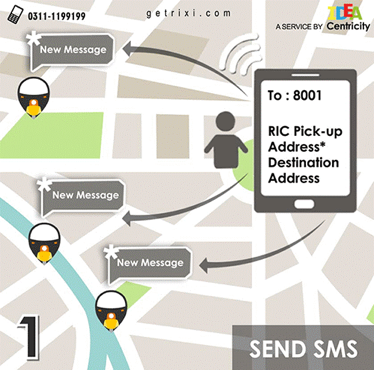
Choose an option based on price and customer rating. The deal is closed. The Rixi driver reaches within 15 minutes.
Rixi is also increasing coverage in different areas. Those interested in including their specific address can send a message to 8001 containing
Also, one can simply subscribe by sending ‘Rixi’ to 8001 to get all the details on ones phone.
As far as modern-day technology solutions go, Rixi’s offering is as straightforward as it gets. Whether or not Rixi’s potential customers feel the same is something that still remains to be seen.
Both Adnan and Hina have come a long way in laying the groundwork for a platform that could have far-reaching consequences for low-income workers across Pakistan. Perhaps their other great success is being role models for the odd ones in Pakistan’s burgeoning entrepreneurial space. By backing their instincts in the face of traditional wisdom, they have managed to survive and prosper — an inspiring story for many bright minds still weighing the risk. This round goes to the odd-jobbers and their latest concept, Rixi.