0
0

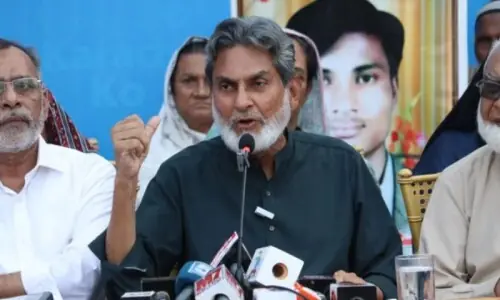
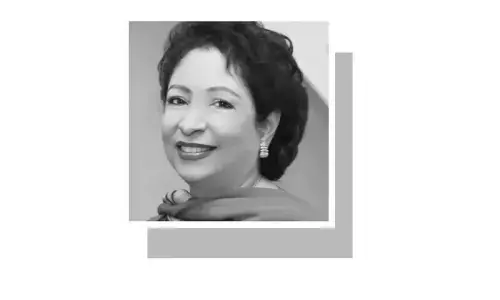
KARACHI: “Jinnah’s vision of Pakistan was that of a secular state, not a theocratic one, but soon after his death radicalisation started taking its roots as secular and progressive forces were crushed,” said human rights activist Dr Habiba Hasan at the international conference on Thursday.
Dr Hasan, a paediatrician, was presenting her paper, ‘Civil society and good governance: a joint venture for the elimination of extremism’, on the second and final day of the conference on ‘Issues of radicalisation in migrant urban societies: a comparative assessment of Pakistan and Europe’. The moot was organised by the Area Study Centre for Europe, the University of Karachi, in collaboration with the Hanns Seidel Foundation.
“The state failed to see the harmful effects of the Objective Resolution, making Pakistan an Islamic republic, nurturing jihadis for Kashmir and Afghanistan and declaring Ahmadis non-Muslims,” she said.
“The pace accelerated greatly in the Zia era when the country was flooded with Kalashnikovs and instead of schools there were thousands of madressahs sprouting hate literature and jihadi culture. Several discriminatory laws such as the blasphemy law and the Hudood Ordinance were brought into force,” she added.
“Now Daesh is looming on the horizon and the civil society and government must address this seriously. The clock must be turned back the way it was brought forward,” she said.
Acting director at the Area Study Centre for Africa, North and South America at the Quaid-i-Azam University, Islamabad, Dr Noman Omar Sattar presented his Eurocentric paper titled ‘Challenges in multi-ethnic and immigrant societies: the assimilation-integration factor’, focusing on Muslims in Europe. He said: “Immigration is pushed by political, economic and other factors. In recent years, ethnic conflict has been a strong force behind immigration from Muslim countries to Europe. Wars in Iraq, Afghanistan and the conflict in Syria now have added impetus to this movement of persons to escape conflict zones and search for better prospects.
“While immigrants have been accepted by many countries, they are unwelcome in many others. The reasons may be cultural or religious along with issues of assimilation and radicalisation linked with terror incidents in Europe and the US. In Europe, the issue has given way to heated debates on the various aspects of Muslim migration, especially after the recent crisis in Syria and the death of an immigrant child who couldn’t make it to a safe harbour,” he said.
Dr Bakare Najimdeen, assistant professor at the department of international relations, Preston University, Islamabad, in his talk discussed the myths and realities of ‘Changing trend and nature of security threat in Europe; role of the diaspora in fostering extremism’.
“Becoming a radical doesn’t happen overnight. People or diaspora are not genetically violent. There are things such as foreign policy, internal dynamics, economic disparity, righteous indignation, sense of persecution, politics of identity, etc, that give rise to youth gangs, white power, skin head groups, terrorist cells, lone actors, political movements, paramilitary groups and anti-Islam movements, which engage in a wide range of activities, spontaneous hate crimes, etc.,” he said.
Former governor of Sindh and federal interior minister retired Lt Gen Moinuddin Haider; resident representative for South Asia of the Institute for the Study of Indo-Pakistan Relations, the University of Leicester, the UK, Ross Masood Husain; consultant, Islamabad Policy Research Institute, reitred Air Commodore Khalid Iqbal; and director at the Area Study Centre for Europe Prof Dr Uzma Shujaat also spoke.
Published in Dawn, October 9th, 2015
On a mobile phone? Get the Dawn Mobile App: Apple Store | Google Play