0
0

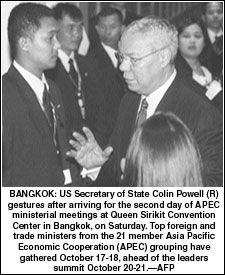 BANGKOK, Oct 18: Twenty-one developing and industrialised economies in the Asia-Pacific region meeting here have agreed to restart stalled talks to free world trade after forging a compromise, officials said on Saturday.
The agreement to push forward with the Doha Round of the World Trade Organisation (WTO) talks was reached at the meeting of trade and foreign ministers of the Asia Pacific Economic Cooperation (APEC) forum ahead of a leaders summit next week.
The ministers agreed that the Doha Development Agenda offers the potential for real gains for all economies, Thai Foreign Minister Surakiart Sathirathai told a media conference, reading a joint statement after chairing the talks.
Particularly, developing economies stood to benefit from the WTO talks in the areas of agriculture reform, improved market access for goods and services, and clarification and improvement of trade disciplines, he said.
An Asian delegate said all 21 APEC economies achieved consensus to soften up on some of their hardline positions.
He said APEC member states would “return to the negotiating table” and this can be reflected in the next WTO meeting in Geneva on December 15, 2003.
US Trade Representative Robert Zoellick said: If a group that diverse can come together with a point of view, that is quite significant.
If this is picked up by other countries around the world, it gives us a much more solid basis to work from in the discussions that are going on to Geneva leading to a meeting by December 15.
Australian Trade Minister Mark Vaile called the meeting “very, very productive”.
WTO members have given themselves until December 15 to revive the current round of negotiations, due to conclude by January 1, 2005.
Thai Commerce Minister Adisai Bodharamik, who co-chaired the APEC talks, said APEC called for a review of the format for future WTO talks to inject “more flexibility and a less confrontational atmosphere”.
This could lead us to reach understanding on critical issues more easily, he said, without elaborating.
A major WTO conference in Cancun, Mexico, last month aimed at pushing forward the latest round of trade liberalisation talks — the Doha Round — collapsed after bickering by developed and developing countries on market access, farming subsidies and tariff structures.
A particular problem was over cross-border investment and competition — the so-called Singapore issues — which added to a more fundamental dispute about richer states’ farming subsidies and the tariffs imposed on agriculture imports by developing nations.
The consensus reached in Bangkok would be incorporated in a statement to be issued by the APEC leaders, including US President George W. Bush, Russia’s Vladimir Putin and China’s President Hu Jintao, after their meeting on October 20-21, the Asian delegate said.
APEC, which represents 2.5 billion people, groups Australia, Brunei, Canada, Chile, China, Hong Kong, Indonesia, Japan, Malaysia, Mexico, New Zealand, Papua New Guinea, Peru, the Philippines, Russia, Singapore, South Korea, Taiwan, Thailand, the United States and Vietnam.
APEC exports are worth around $3.8 trillion, officials say. Average tariff levels among APEC member states is less than eight per cent and two-thirds of APEC trade is at tariff levels of five per cent or less.
Officials said developing nations at the APEC meeting wanted the issue over market access to be tackled first.
The industrialised nations agreed but wanted some movement on at least one of the Singapore issues: transparency, government procurement, investment and competition policy.
Canada suggested that the four issues be “unbundled” as a “practical attitude to move forward” and the developing economies said they were willing to accept “these practical suggestions,” a delegate said.
Singapore told the meeting that the WTO negotiations under the Doha Round should not be expected to finish by 2005, he said.
Other economies said: why should it matter that the negotiations be finished by 2005 when the (preceding) Uruguay Round took longer than expected? —AFP