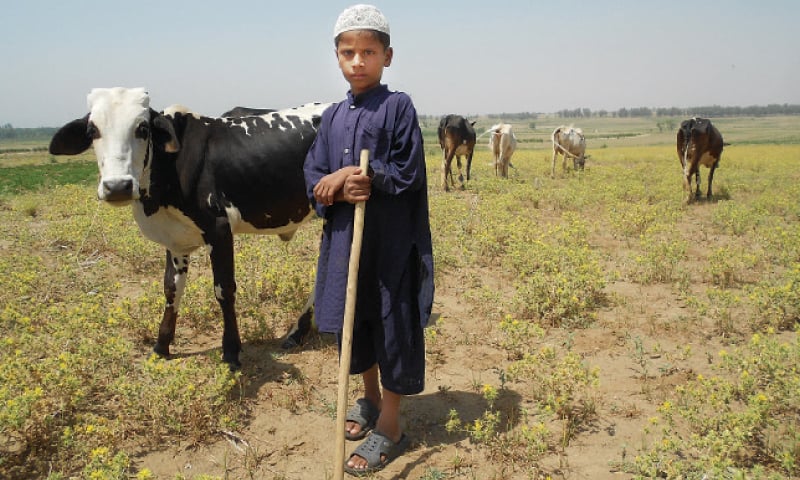
SWABI: The centuries-old tradition of grazing livestock, mostly by children, is still alive in parts of Swabi district, especially in areas situated near rangeland terrains.
Farmers belonging to different areas of the district told this correspondent that grazing herds was centuries-old profession adopted in areas with vast rangelands, enabling the farmers to easily earn livelihood.
However, they complained that the grazing areas had been vanishing with the rapid growth in population.
The main grazing area in Chota Lahor tehsil is of 16,000 kanals. The right to graze cattle in grasslands is still enjoyed by all sections of the society here. “The continued deterioration of rangelands has badly affected the livestock farming community here,” said Rahim Dad of Shagai village.
People in remote areas usefully graze their own animals, but there is also a system where a herdsman is given salary or grain for grazing cattle of several families. “The herdsman is usually given wheat and maize. This practice has worked for centuries in the farming belts and is still in alive here in the district,” said Shahbaz Khan of Saleem Khan village.
However, Jabeen Qamar, a landowner of Jalbai village, said that due to population explosion the demand for food had increased manifold, forcing the farmers to bring more grasslands under cultivation and irrigation, leading to reduction of grazing fields.
The farmers said that population growth had put pressure on fertile land and vegetation with the residents going for cutting trees for domestic fuel, harming the grazing land and environment.
Farmers cultivating rangelands as demand for food grains grows
Khan Aman, an agriculturalist in Maini village, said that due to extra activities of the people the grasses, legumes, herbs, shrubs and trees growing on the rangelands had been damaged badly and now low quality vegetation had started growing over there. This has caused great financial loss to the cattle owners.
“We just failed to think about the cattle farming and adopt precautionary measures to save animals,” he said. Inadequate forage during prolonged dry period has also caused heavy losses of livestock in the district.
The livelihood of farmers is linked with agriculture yield and livestock production.
The rangelands provide fodder for animal herds, but in case of little rainfall we can’t get the fodder easily, said vet Dr Abid Ali. Whenever there is prolonged dry spell it reduces fodder production, creating problems for the cattle owners and affecting their livelihood and income from crops.
The farmers said that when cattle could not get the required fodder from the rangelands it harmed the health of the animals, resulting in low productivity of milk and meat. Subsequently, the poor peasants, who continuously remain in search of livelihood, abandon their land and move towards cities. “It is, therefore, imperative to take remedial measures to assist these people and help them in their field,” said Dr Abid.
The peasants face problems in providing sufficient fodder to their animals in the start of spring and in winter. Also, the civil society activists have been calling for keeping children away from grazing cattle. They say that the government should devise a strategy to arrange for their education.
Published in Dawn, June 22nd, 2015
On a mobile phone? Get the Dawn Mobile App: Apple Store | Google Play