0
0

WASHINGTON, Oct 5: There’s nothing unusual about a sudden increase in bilateral contacts between the United States and Pakistan because as allies in the war against terror, they need to talk to each other regularly, says Foreign Minister Khurshid Mahmud Kasuri.
Commenting on a string of meetings between US and Pakistani leaders and senior officials, the foreign minister told Dawn: “We keep talking, whether it is about Afghanistan, Central Asia, Iraq, defence issues or other matters.”
“There are developments on each of these fronts that require frequent interaction,” said Mr Kasuri who was visiting the United States along with the prime minister but had to return to Islamabad for talks with US Deputy Secretary of State Richard Armitage.
Pakistan and the United States have been constantly engaged with each other since mid September when Defence Secretary Hamid Nawaz Khan came to Washington to attend a meeting of the joint defence consultative group.
This was followed by a visit to New York by President Pervez Musharraf who also met President George W. Bush on the sidelines of the UN General Assembly. Soon after the president, Prime Minister Zafarullah Khan Jamali came to Washington for his first official visit to the US capital. The prime minister is now in New York and will visit Chicago before returning to Pakistan early next week.
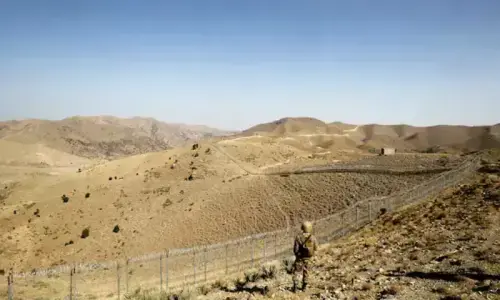
And while the prime minister is still here, a senior State Department delegation is opening dialogue in Islamabad on several sensitive subjects such as the resurgence of Taliban activities along the Pakistan-Afghanistan border, the US request for troops for Iraq, and the Indo-Pakistan relations.
Gen Mohammed Aziz Khan, chairman of the Joint Chief of Staff Committee, will be in the United States from Oct 13 to 21 for talks with senior defence officials in Washington and at the headquarters of the US Central Command in Florida.
Foreign Minister Kasuri, however, sees nothing “unusual” in these high-level contacts between the two countries and says that “they reflect positively on US-Pakistan relations.”
But he acknowledges that “some in the United States” have complained that Pakistan is “not as enthusiastic about fighting the Taliban as it is against Al Qaeda.”
“Such assumptions are absolutely incorrect. The government of Pakistan was involved in the removal of the Taliban government, which earned their enmity and displeasure. It makes no sense first to remove them and earn their enmity and then to bring them back.”
The lobbies not happy with US-Pakistan relations, said Mr Kasuri, were orchestrating such propaganda. Last week’s action in Waziristan, where Pakistani troops killed more than a dozen Al Qaeda activists, disprove the allegations against Pakistan, he added.
When suggested that the action might have been timed to coincide with the prime minister’s visit, the foreign minister said: “There exists a very close cooperation between the intelligence agencies of Pakistan and the United States. The CIA is working with the ISI in these areas. They would know if we plan such a thing and would not want Pakistan to reap political benefits from such operations.”
Mr Kasuri said he was aware that “some in the Afghan government” were trying to blame Pakistan for everything happening inside Afghanistan.
“Normally, I would not comment on the internal affairs of another state but such allegations have a direct impact on our relations with a brotherly country, so I cannot desist from saying that it is a common human failing to shift the burden on others.”
The foreign minister said Pakistan believes that the situation in Afghanistan will settle down after the terms of the Bonn agreement, signed after the 9-11 terrorist attacks two years ago to bring a new government in Kabul, “have been faithfully implemented.”
The Bonn agreement, he says, stipulates general elections in Afghanistan for electing a setup in which all stake-holders are appropriately represented.
Mr Kasuri said that Pakistan has extended “very close cooperation” to the Afghan government and trade between the two countries has doubled to $400 million this year. “We are also reviewing the negative trade list for reducing duties on Afghan goods and for further expanding trade with that country. We are not a rich country but we have earmarked $100 million for reconstruction projects and a substantial part of this amount has already been released,” he added.
He said that Afghan Foreign Minister Abdullah Abdullah, who was also in New York last week, admitted in the presence of Iranian foreign minister that “there’s very close cooperation between the intelligence agencies of the countries.”
Mr Kasuri said that a vocal minority in Pakistan was “making an issue out of our Afghan policy, we need to make sure that we carry our people along on issues like Afghanistan and Iraq, and we will.”