13
13


KARACHI: While Russia had maintained a low profile in the post-Cold War era due to domestic challenges, things began to change at the turn of the millennium with the result that it again became an assertive player in the realm of foreign policy. This can be seen in its relations with central Asian countries, as it calls for peaceful resolutions of the conflicts tearing the Middle East apart and its bilateral relations with Pakistan, Afghanistan and India.
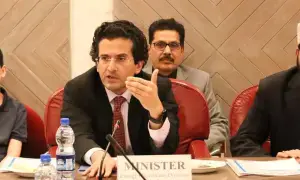
Russian Ambassador Alexey Y. Dedov expressed these thoughts while delivering a talk on ‘New Trends in Russian Foreign Policy and Future Challenges’ on Friday. The event was held in the council room at the dean of the faculty of social sciences, Karachi University.
Take a look: Pakistan, Russia sign landmark defence cooperation agreement
Discussing relations between Russia and Pakistan, he said the ties were far more robust and were undergoing a renaissance. “Pakistan and Russia have been through many ups and downs. They were excellent during the time of Ayub Khan and Zulfikar Ali Bhutto but then they became strained.” He said that Pakistan was its main partner in the region and read out President Putin’s quote about Pakistan’s importance to Russia in which he said that “Russia attaches great importance to Pakistan and this is because of its stipulated role in the Muslim Ummah”.
He spoke about increasing political ties that includes the upcoming visit of the Pakistani prime minister and recent visit of Pakistani parliamentarians to Russia and vice versa. About technical cooperation, he said talks were under way for supply of helicopters to Pakistan for its counterterrorism activities and a proposal to build a gas pipeline from Karachi to Lahore among other things.
He also emphasised his country’s longstanding relations with India, arguing that Pakistan should not be concerned about it since Russia’s relations between the countries was independent of each other.
About Afghanistan, he said it was a matter of great concern as “it was a potential hotbed for terrorism and drugs. The Islamic Movement of Uzbekistan that claimed the attack on Karachi airport in 2014, is operating from Afghanistan and is exerting its influence also on our central Asian allies.”
However, Mr Dedov said, Russia trained Afghanistan’s police and provided them weaponry and was also working on building electricity projects.
About the Yemen conflict, Mr Dedov said: “The political engineering needs to be seen” there. There had been instances where the UN Security Council’s approval was sought for establishing no-fly zones and carrying out air strikes, he said. But in the case of Yemen, for instance, no such approval was sought, he added.
The ambassador said he had spoken to Pakistani government officials on the matter and they, too, wanted a peaceful solution and called for dialogue. “It is not just a sectarian conflict in Yemen but it is much more complex,” Mr Dedov explained.
He also spoke about Russia’s evacuation efforts in Yemen. “We not only evacuated our citizens but also moved out citizens belonging to the central Asian countries. We evacuated nearly 1,000 persons.”
However, he said, the conflict in Syria and the control of the self-styled Islamic State in the country could be called “dangerous”, “uncontrolled” and “unprecedented”.
Comparing the IS to other terrorist organisations, he said, the crucial difference was that it had its own state. “It has population of over one million and they export oil and gas at competitive market prices,” he added.
The ambassador indirectly put the blame of the present conditions in Libya on the Western forces, explaining that one was not saying that Muammar Qadhafi was a noble guy but the country was in such dire straits after his departure that not only was it controlled by various militant groups but even the IS had extended its control in the country.
He also touched Crimea and East Ukraine, saying that Crimea had chosen to re-unite with Russia through a referendum. He blamed “external influence” for escalating the conflict in East Ukraine.
Published in Dawn, April 11th, 2015
On a mobile phone? Get the Dawn Mobile App: Apple Store | Google Play