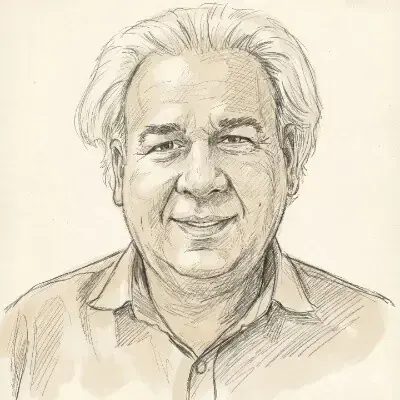
KARACHI: It is believed that we’re living in the era of Mushtaq Ahmed Yousufi’s humour — in Urdu literature, that is. Not many would take issue with that. The writer tickles your funny bones like no one else primarily because of his remarkable ability to develop a comical situation and top it off with a hilarious punchline. It sounds simple. It is not.
Mr Yousufi is an extremely learned man. So his scholarly bent and creative pursuits get on like a house on fire. Is he someone who can be read out loud, in front of an audience? This question was answered in the affirmative during the penultimate performance on Friday night at the fourth National Academy of Performing Arts Theatre Festival when the group Dastango read out, almost dramatised, extended excerpts from Mr Yousufi’s celebrated book Aab-i-Gum.
A dastango is a raconteur. He tells stories, orally. That’s what the three artists — Meesam Naqvi, Nazrul Hasan and Fawad Khan — set out to do; tell Mr Yousufi’s stories like he does. The first step: pick the right piece. That box was ticked. Aab-i-Gum has many strands which can be performed. The one that the artists chose, chiefly, was to do with the famous Qibla who sold wood.
The tale begins from pre-partition Kanpur where the mulish, full-of-himself Qibla resides. His character is unravelled layer by layer by the three storytellers. An incident where he fails to control his temper results in injuring his competitor in the market and lands him in jail; yet two years of incarceration doesn’t turn him into a different man. In fact, Qibla gets more stubborn.
The Partition of the subcontinent happens and Qibla has to migrate to Karachi. The shift is physically smooth but has psychological ramifications. He has a picture of his haveli with him and whenever he wants to impress anyone or prove who he actually is, he holds up that picture and says, “Ye chhor ker aaey hain” (this is what I left behind in Kanpur).
As the story unfolds, Yousufi’s guffaw-eliciting one-liners keep coming up, such as “Azad shaeri aisey hai jaisey baghair net ke tennis” (free verse is like playing tennis without the net); or “Karachi ka machhar sirf qawwalon ki taali se marta hai” (Karachi’s mosquitoes get squashed only by the clapping qawwals).
Among the three storytellers, actors if you like, Nazrul Hasan was the one who enjoyed what he was doing. That lent verisimilitude to his performance. No surprises that he earned applause nearly every time he delivered a punchline. Meesam Naqvi was fine too. But Fawad Khan appeared to be a bit nervous, therefore struggled with quite a few lines. Nonetheless, Dastango’s effort was worth watching, because it reminded us that we still have geniuses like Mushtaq Ahmed Yousufi in our midst.
PS: Why do storytellers have to wear traditional dresses to tell a story, especially when it’s a Yousufi script and not a Mir Baqar tale?
Published in Dawn, April 4th, 2015
On a mobile phone? Get the Dawn Mobile App: Apple Store | Google Play