0
0

ISLAMABAD, Sept 25: The Asian Development Bank on Thursday proposed $200 million for the SME sector development programme for this year to further strengthen the private sector by providing better access to finance for SMEs, capacity building, partial credit guarantee facility to financial institutions to increase their capacity and restructuring of SME Bank.
Speaking at a seminar on “ADB Private Sector Development Strategy”, ADB Country Director Marshuk Ali Shah observed that Pakistan was the single largest recipient of the bank’s direct assistance to the private sector amongst all development member countries of the ADB.
Total assistance to the sector now stood at $402 million (Rs14 billion), including $241 million as assistance to private sector enterprises and over $129 million as complementary loans.
In addition to the direct assistance provided to the private sector, the ADB generates business opportunities for the private sector through its public sector activities and helps governments create enabling conditions for private sector investment. In this connection, it had provided more than $2 billion so far. He said an SME Sector Development Programme for $200 million was proposed for this year.
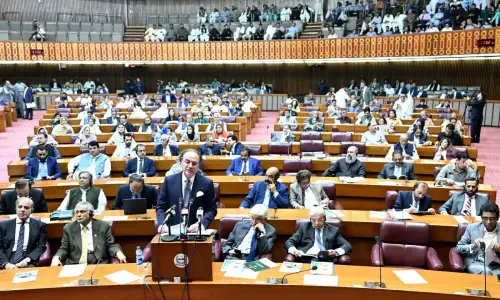
Privatization and Investment Minister Dr Hafiz Sheikh on the occasion assured the Asian Development Bank of his government’s full support in its programme for strengthening private sector, particularly the SME sector in view of its role in economic development.
The minister commended the ADB’s decision to launch a Public-Private Infrastructure Finance Project for $200 million.
Referring to his experience of working with the World Bank and as adviser to the government of Sindh, he said it was for the government to set the pace for multilateral agencies in the initiatives for development and not vice versa.
He said the present government was quite pro-business and had effected far-reaching modifications in the rules of game. He, however, regretted that the response of investors to the investment opportunities now existing in Pakistan was rather tardy.
Robert Bestani, Director General, Private Sector Operations Department in the ADB Headquarters in Manila, said the ADB had identified a number of new areas for fresh financing. One of these was “trade financing”. This project was modelled on the project launched by the European Bank. He, was, however, sure that in Asia, given its diversity of countries, it would be even more successful.
Another area was the non-performing loans — a problem faced by many countries. Only Korea had successfully tackled it so far. One of the ideas in this regard was the sale of these “assets” to the asset management companies.
It was also proposed to develop housing finance, municipal funding, political risk insurance as the areas into which money could be funnelled with innovative schemes for its profitable investment, he added.
The ADB would hold similar seminars at Lahore and Karachi.
In Islamabad, however, to the visible chagrin of the ADB country director, the presence of local businessmen in the seminar was almost nil and it was attended mainly by senior government officials. From the private sector, only the Citibank was represented.