
AS I take a seat in the drawing room of a small house in the Kot Ganesh locality of Chakwal city, a young voice greets me. The child, her father says, is 13 years old but given her pale complexion and her thin physique, she looks much younger.
Nalain Rubab Imran is excited because she, along with her parents and a donor, are set to leave for India for the re-transplantation of her liver at New Delhi’s Apollo Hospital. “I will buy lehngas and jewellery like those worn by Phool Kanwal and Ajab Dev [characters in a popular television drama telecast from New Delhi],” she says, smiling. “Papa said these things will be available there.” Her father, Hamid Imran, nods indulgently.
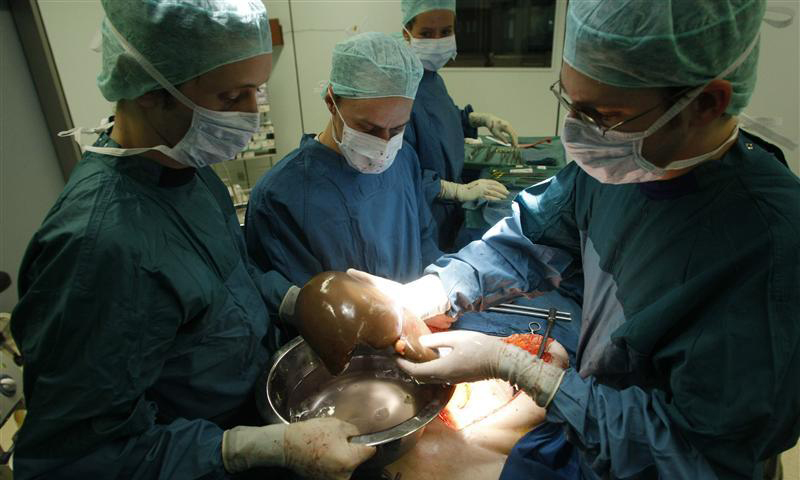
According to liver transplant experts at the Shifa International Hospitals, Islamabad, between 700 and 800 Pakistani patients undergo liver transplantation procedures abroad every year, spending about $4 million annually. Meanwhile, more than 500 Pakistanis have received liver transplantations in India so far. Hamid has no plausible option other than taking his ailing daughter to Delhi, as in Pakistan there are insufficient facilities for the procedure she requires.
Take a look: Liver transplant facility
Nalain was studying at the Myers School in Chakwal, and she was a shining pupil. She topped the Grade 5 exams.
“One day in September 2011, she returned from school with fever,” recalls her father, who worked for the ministry of health in Saudi Arabia. Upon learning of his daughter’s illness, he rushed to Pakistan and took her to a hospital in Islamabad where she was diagnosed with liver disease. The doctors at the Shifa International Hospitals said that she needed liver transplant. “At that time, doctors told me that it would take Rs8.5 million for transplantation, and I could not arrange such a hefty amount,” he says.
Hamid brought the matter to the notice of his employers in Saudi Arabia and the then prince and now King Salman turned out to be a messiah; Hamid took his daughter to Saudi Arabia where Nalain’s mother donated liver tissue to her daughter. Thus the child got her liver transplant.
But seven months later, the problem surfaced again — chronic rejection. A distressed Hamid was told to get his daughter a re-transplantation procedure but there was no one in the family whose blood group matched that of Nalain. And Saudi rules allow only a family member who is not more than 35 years of age to be a donor.
Hamid had to return to Pakistan and arrange substantial funds for a re-transplantation procedure. “I managed to voice my problem from the platform of a TV channel in 2013 and my cry was heard by Amber Riaz Malik, who took responsibility for all the expenses of a re-transplantation,” he tells me.
In Pakistan, liver transplantations are successfully being carried out at the Shifa International Hospitals. But Hamid says that re-transplantation has not been conducted so far in the country.
“I decided to take my daughter to Apollo Hospital which is famous for liver transplantation,” he explains. “Manzoor Hussain, the uncle of my wife, is going with us to donate tissue.” Nalain herself says she wants to become a liver surgeon one day. “I do not want to see people like me, I want to see them healthy,” she asserts.
Hamid is lucky as he is aware about the possibility of organ transplantation. “Due to the high prevalence of chronic viral hepatitis and the additional, significant, burden of other chronic adult and childhood liver diseases, it is estimated that more than half a million people will develop end-stage liver disease or hepatocellular cancer. Not all cases are suitable for a transplant but a substantial number are,” says Dr Najamul Hassan Shah, director of the liver transplant department at the Shifa International Hospitals where about 10 liver transplants are conducted monthly. He adds that successful liver transplant surgery has been conducted at the Sindh Institute of Urology and Transplantation in Karachi, the Masood Hospital, Lahore, and Sheikh Zayed Hospital, Lahore, by foreign surgeons. But the process could not be continued because of the unavailability of local surgeons.
“Hepatitis C is the major reason for liver failure requiring liver transplant,” says Dr Faisal Saud Dar, consultant in liver transplantation, hepatobiliary and pancreatic surgery at the Shifa International Hospitals. Other indications include Hepatitis B, autoimmune liver diseases and congenital liver diseases in children while the total expenditure for one liver transplant surgery is Rs4.5 million.”
Dr Shah and Dr Dar are emphatic that all these figures suggest a great need for more and larger liver transplant centres in Pakistan as a matter of priority. “Government hospitals need to be upgraded to a level where liver transplants can be done safely. They need to hire competent and appropriately trained professionals, and have incentives built into the system where professionals are rewarded,” says Dr Dar. “That’s the only way to get liver transplants started in public-sector hospitals.”
Published in Dawn, March 20th, 2015
On a mobile phone? Get the Dawn Mobile App: Apple Store | Google Play