



 0
0

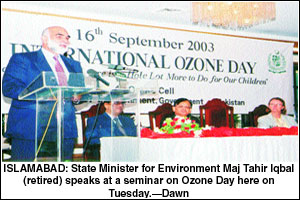 ISLAMABAD, Sept 16: All Pakistan Refrigerator Manufacturers Association on Tuesday announced to phase out the use of Ozone Depletion Substances (ODS) by the end of 2008 instead of 2010 to save life on the earth.
The decision was in line with the Montreal Protocol to discourage the use of Chloroflorocarbons (CFCs), Halons, Carbon Tetra Chloride (CTC) and Methyle Bromide by 2010 worldwide.
The announcement was made during a function organized in connection with the International Day of Ozone Layer Preservation organized by Ministry of Environment and United Nations Development Programme (UNDP) here on Tuesday.
The theme of this year is “Save Our Sky: There is Hole lot to do for our children.”
The representatives of the refrigeration industry said they had successfully achieved 50 per cent goals of the Montreal Protocol to phase out ODS, because, according to environment experts, the ODS was responsible for the depletion of the Ozone Layer.
Speaking on the occasion, Tahir Iqbal, Minister of State for Environment, said depletion of Ozone layer was one of the major problems confronting the world today which was also responsible for the loss of biodiversity, degradation of the ecosystems, drought and desertification, loss of forests, disposal of solid and liquid waste and vehicular and industrial pollution.
The complexities of the environmental problems were such that these were no longer confined to the country that may have been responsible for the environmental degradation in the first place, Mr Sadiq said, emphasising the need for the entire world community to join hands to protect the environment.
He said the theme of the function reminded us that considerable efforts were required to stop further depletion of the Ozone layer.
The developed world has already phased out the use of ODS and now the developing countries should also stop using this substance, he added.
The minister said the Ozone Cell of the education ministry had provided support to about 10 major industries in the country to phase out 430 metric tons of CFCs. Thirteen other industries were also in different stages of completion, he added.
The environment ministry was also providing assistance through the World bank and the UNIDO to 23 local industries, which were in different stages of conversion to the Ozone-friendly technology, the minister announced.




























