0
0

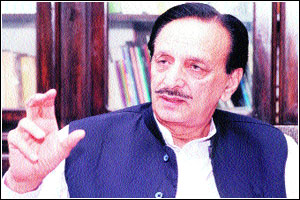 ISLAMABAD: The following is the edited text of the Dawn Dialogue interview with Pakistan Muslim League-N chairman Raja Zafarul Haq:
QUESTION: As one who has associated with both military and civilian governments and as chairman of one of Pakistan’s major political parties, how do you see the country’s political future?
ANSWER: I feel this period we are passing through today is the most crucial and most difficult. With the passage of time, one had hoped that we would learn lessons from our past experiences, which were very costly and bitter. But it seems we are still going down. The values of political life are declining and military takeovers have also debilitated society, weakened institutions, and this time it has done the worst. They claimed that they will bring real democracy to the country, but the fact is that the kind of people we see in our political institutions, they are disappointing. The constitution was manipulated, meddled with in such a massive fashion that now you find it very difficult to really make out what was the previous 1973 Constitution (from) what is now the constitutional set-up, which is very sad. And every now and then we hear that the national spirit is weakening and the vital interests of the country are suffering. And the political atmosphere is such that instead of giving hope, the present political institutions are gasping for breath.
If we had learnt any lessons and really wanted to establish real democracy in the country, we would certainly go for proportional representation. That would eliminate the constituency manipulation which has undermined national politics. People have been concentrating on their constituencies irrespective of what happens to the national interest. Right or wrong, one has to get votes, they spend money and oblige their constituents, whatever the national cost. This has really degraded politics.
The role money is playing in politics is also increasing. Every election brings new records of money-spending. Whatever the laws (prescribe) — that a candidate cannot spend beyond so much — nobody bothers. With the passage of time people purchase votes for membership of the Senate, National Assembly and the provincial assemblies.
Q: Don’t you think this is happening all over the world?
A: No, not on this magnitude. I admit that in democracy money does matter, but not the way it has influenced results in Pakistan.
Q: Was there any move when you were in the Nawaz Sharif government to bring in an amendment to the Constitution to rectify this situation?
A: Yes, we had introduced the proportional representation system in our manifesto. It couldn’t be implemented because there was a sudden crack.
Q: Was it to be partially implemented or was it for the whole assembly?
A: This was to be debated, because there are systems, for example, in Germany, where half of the seats are (elected under) the first-past-the-post (system) and the other half by proportional representation. We could have gone for this, and we could have nominated for membership of the Senate as well as the National Assembly the best available people in the country.
Q: While all military governments have been blaming politicians for the political turmoil and instability, who do you think is the main culprit, political parties or the military establishment?
A: I think the truth is somewhere in-between. The military has been in power for more than half of the life of the country and politicians have also not fared very well. They had no sense of sacrifice, they did not uphold the higher principles of national life. Financial and political integrity, which is demanded of national leaderships, was also missing. So it is both ways. I feel if the political segment of society is comparatively clean .... and a little superior to the rest of the people, then I think (it could make a difference). You see leadership in other countries, for example, Mahathir Mohammad (in Malaysia), and I would also rate (Indian Prime Minister) Mr Vajpayee as one of the very clean politicians in a sense that there are no allegations against them personally. Similarly, there are our own examples of the Quaid-i-Azam, Liaquat Ali Khan, Sardar Nishtar and Khwaja Nazimuddin. They were very clean people. So if the political segment is cleaner, it affects the rest of the life of the nation. But if that is not clean, I think that affects the whole nation in a negative way.
Q: Were there any weaknesses in your party’s government that led to the army intervention in 1999?
A: It was not weakness, because the final verdict which was given by General Pervez Musharraf was that “if Nawaz Sharif had not dismissed me, he would have been prime minister even today”. Justice Rehmat Hussain Jafri, who tried Nawaz Sharif for that case in Karachi (for hijacking), said in his judgment that “I am not awarding him the maximum punishment because I feel from the evidence and from the material produced before me — some material was also produced before him in-camera — .... that Nawaz Sharif was only reacting to the efforts at undermining his authority as prime minister and defence minister of Pakistan”. So the initiative was on the other side. After the debacle in Kargil, it was only a question of who takes the initiative, the prime minister as defence minister or the army leadership, which was involved in the Kargil affair. So it was touch and go.
Q: Who was responsible for Kargil?
A: I think there is no doubt about it who was responsible, because the other day, in a discussion with some parliamentarians from India, General Pervez Musharraf said ‘we had done it to highlight the Kashmir issue’. But we had demanded, right in the beginning, when the Pakistan Muslim League had a central executive meeting in Peshawar, that there should be a commission appointed to go through all the elements, all the aspects of the Kargil episode....
In one of the meetings, there was a demand that action should be taken against those people who had unnecessarily done this thing. But it was inconclusive, it was not fully debated, as far as I remember. And I had the facility of attending almost all meetings of the cabinet defence committee and I was associated with most of the things at that time. I was leader of the house in the Senate and a member of the cabinet. I didn’t have the portfolio of defence with me nor of foreign affairs, but I was associated with the meetings of the defence committee where the military and political leadership sat together, from the initial stages of Kargil to the finish.
Q: Was the Kargil operation discussed in those meetings before it was started?
A: It was discussed not in the sense that it should be done or it should be launched or not launched, but it was discussed as to why it was started. Why did they start it, and in a manner in which even the air force and navy as well as the foreign office, the ministry of Kashmir affairs, and the secretary of defence did not know about it. It was the secretary of defence who brought it to our notice that they are doing it and we will have a hit-back, there are repercussions and we shouldn’t have done it. It was (defence secretary retired lieutenant-general) Iftikhar at that time who had brought it to the notice of the prime minister and some other ministers that this should not have been done.
Q: What do you think is the way out of the constitutional crisis facing the country?
A: It is not the first time the military has taken over in Pakistan. Previously what they had been doing (was different). When Ayub Khan brought a new constitution in 1962 he put it before the newly-elected National Assembly. General Ziaul Haq made a very large number of amendments in the Constitution through the presidential order 14 of 1985 but he placed everything before parliament, and whatever was accepted is now known as the Eighth Amendment and what was not was thrown out. That is how he carried the assembly along with him. General Pervez Musharraf was ill-advised. Number one, they told him that ‘you need not go through the process of parliament’, and number two that ‘you need not get any cover from parliament for whatever you have done for three years’. So he said ‘I don’t need any cover and I don’t need anybody’s endorsement — whatever I have done is already a part of the Constitution.’ This is unusual, this is unheard of in the constitutional history of the world because modern constitutionalism is over 200 years old and every country, by and large, has a written constitution and procedures, barring small differences of whether it is a parliamentary system or a presidential system or some institutions which are home-grown in some of the countries.
Q: What is the way out?
A: The way out is only for there to be realization in the ruling sections of our society that parliament, the elected body of the people of Pakistan, has the right to lay down the rules and none else. Some people say what is the importance of the LFO? It is not a question of the LFO, it is a question of a basic principle: whether the will of the people of Pakistan will prevail or the will of an individual or a group of people will prevail. It is a very basic question. It is a question of life and death for this nation.
Q: Do you think they should follow the same process as done for the Eighth Amendment?
A: Whether they follow the same or a different process, they should admit that it is the right of the people of Pakistan to make a constitution for themselves. The rules of the game have to be made by the people of Pakistan through their representatives, and this is the preamble of the constitution of Pakistan. Democracy means that this right should be given to the people and not to an individual. There is absolutely no divine rights of the king today.
Q: If all these things remain there, do you foresee any trouble as the opposition has often threatened to bring out the people in the streets?
A: There could be a very bitter end to this tussle. They should all try to avoid it. We are for the first time in our national history in a situation where our borders on all four fronts are not safe. I feel that there should be a greater realization in the defence services of Pakistan because they are primarily concerned with the question of the integrity of the country. They should not push things to a level where this ugly situation turns uglier. Even today, the whole world knows that the system is not working. The whole system is manipulated.
Q: Do you see any danger of even these “manipulated” assemblies being packed up because of the LFO controversy?
A: I feel that the life of this assembly is important, but the life of the nation and the country is more important. There is no contradiction between the two, but if you go by the relative importance, I feel that they should settle it. If they are ruling this country, they should rule according to the principles of the Constitution. The opposition can wait; we are not impatient. But if they push things to a level where it starts hurting the integrity of the country, we have no other place to go back. Even today, internationally, amongst our so-called neighbours and so-called friends, it is being discussed that Pakistan is a failed state. Let us not strengthen this impression.
Q: What do you think about the foreign policy of the present government?
A: It is very difficult for developing countries to have a totally independent foreign policy because of so many pressures. In the present situation, it has been made well nigh impossible for Pakistan to have an independent foreign policy. The course we have taken after September 11, 2001 has set us in a channel which does not lead to either an independent foreign policy or an independent internal policy. We are running the country on a course which is not determined by us. Isn’t it an irony of fate that General Pervez Musharraf said: ‘I had no other option when I agreed to what the United States said, it was forced on me”. And he tried to assure the nation that it’s a very short campaign in Afghanistan, targeted, calibrated and short, it will finish in a very short period of time’. Bang came the retort from the American president, who said ‘who told him that it would be a short and targeted campaign?’ So the initial step which was taken was not a free step. And he admitted that it is not a free step. But every now and then people from outside came and said ‘You have taken a very bold stand’. He said, “I have not taken any stand, it was foisted on me by force of circumstances’. They said ‘No, you have taken a very bold stand, please continue on the same course’. And they take a lot of credit in getting the certificates that we are in the forefront of the war against terror.
Q: Was there any alternative course available?
A: Discussing alternatives today ... will be an exercise in futility. We just can’t turn back the hands of the clock. Hindsight would tell you that there could have been several (alternatives). But the fact is that what the situation is on our borders with Afghanistan was unimaginable two years back. What is the state of relations with our neighbours, especially Iran, was unimaginable two years back. The development of diplomatic relations between India and China is also another story. Although the Chinese remain our friends, they also know that we have our priorities fixed somewhere else.
Q: Are you convinced that the government tried to marginalize the mainstream parties by encouraging the MMA?
A: Yes. Not only encouraging the MMA, they did everything. Not only did they marginalize, they made laws and amendments and continued doing it before, during and after the elections... (such as) barring anybody from becoming prime minister for more than two times. Now which parliamentary system in the world has this law? It was only person-specific. When somebody told them that one of the leaders of the opposition parties doesn’t have a graduation degree, they made this thing (that a parliament member must a graduate). So everything was done to ensure that they (top opposition leaders) don’t participate in the elections, they don’t come back.
Q: Are press reports true that the ARD leadership is trying to bring back Nawaz Sharif and Benazir Bhutto to give a momentum to the movement against military rule?
A: I feel there could be some developments. I am not sure how long they will take to materialize.
Q: Should Nawaz Sharif and his brother Shahbaz Sharif come back or not?
A: I think they should come back to Pakistan.
Q: Will there be no danger of their being put in jail?
A: So what? One has to go through this discomfort and humiliation.
Q: Despite their agreement to remain in exile for 10 years?
A: I haven’t seen any paper which says they have to remain outside for 10 years.
Q: Was it a verbal agreement?
A: I don’t know. I am not aware of any such thing. I met Nawaz Sharif and Shahbaz Sharif several times in Jeddah and they didn’t tell me there was some agreement. I believe it was like when Mr Bhutto was being tried, several heads of state and government who had a feeling for him had tried that he should be handed over to them and he could live there. In that case, it was not acceded to. This time it succeeded and Saudi Arabia and Qatar and many countries said don’t harm him, give him to us and then, under the circumstances, he agreed.
Q: Do you think the military should have a role in running Pakistan?
A: No. Stephen Cohen (the American author and analyst) said in an article that the Pakistani military had no training to develop or keep the nation together. But even if he had not written it, don’t we realize ourselves that it is not their cup of tea? If they keep themselves to their profession — it is a very majestic profession, an honourable profession, defending the frontiers of the country — they will win respect in the hearts of the people. Now what is the situation? I am not quoting somebody from the opposition, I am quoting the wife of former chairman of the Joint Chiefs of Staff Committee General Shamim Alam. She is a member of the Senate and she said that unfortunately in the hearts of the people of Pakistan there is no respect left for the armed forces.... This situation is not in the interest of the country. They should realize it.
— The interview panel comprised
Raja Asghar and Amir Wasim.