



 0
0

 LAHORE, Sept 14: The Unesco has proposed to demolish over 100 houses along the Shalamar Gardens to establish a buffer zone around it to protect the monument. It has also proposed to pay Rs1 million each to the owners of the demolished houses.
Encroachments all around the Shalamar Gardens are a major threat to its existence. According to the Antiquity Act of 1975, no construction is allowed within 200 feet of any monument.
Federal archaeology department officials told Dawn that Unesco had also asked the government to contribute to the compensation.
Though the officials did not give the exact date for the establishment of the buffer zone, they said the work would begin after negotiations with the dwellers whose dwellings were proposed to be demolished next year.
The officials said the level of land outside the gardens had risen four feet above the level inside. They said traffic on the road outside was also a threat to the monument.
After the establishment of the buffer zone, they said the traffic outside the gardens would also be diverted.
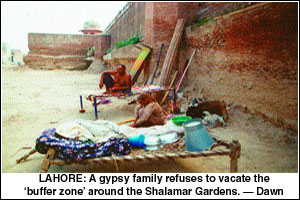
Meanwhile, the City District Government, on the request of the federal archaeology department, removed some eight gypsy families who had encroached the eastern wall of the Shalamar Gardens. But one of the families — an elderly woman and her husband — also seen in the picture refused to vacate the place. The woman, Bavi, said that she had no place to live, urging the authorities concerned to provide a place before displacing her.
The officials also said the unique hydraulic system of the Shalamar Gardens would be restored next year with the financial assistance of Britain and France. The Unesco will secure funds from the respective governments.
The hydraulic system of the monument was a part of the Inayat and Angoori Baghs built by Mughal Emperor Shah Jahan in 1642. These gardens do not exist as houses and markets have taken their place.
The hydraulic system was planned in such a way that the arrangements and placement of pipelines ran at a depth of 1.8 metre under the canal bed. The technique was evolved for running fountains and giving a long choke-free life to the underground water supply system.
During the British rule, the hydraulic system was disconnected from the Shalamar Gardens due to the reconstruction of the GT Road.
Archaeological officials said the Punjab government, in 1998, had ordered demolition of the 50 per cent of the system to widen the road. The adjoining fountain built by the Lahore Development Authority was also demolished.
Further demolition of the hydraulic structure was stopped when the army took over in 1999. It was then decided that the government would not widen the road without the permission of the archaeology department. However, the archaeology department was asked to take measures to protect the intact portion of the hydraulic system.
The Shalamar Gardens is on the world heritage list besides archaeological site of Moenjodaro, historic monuments of Thatha, archaeological remains of Taxila, Buddhist ruins of Takht-i-Bhai, city remains at Sehri Bahlol, Rohtas Fort and Lahore Fort in Pakistan. —Zulqernain Tahir


























