18
18


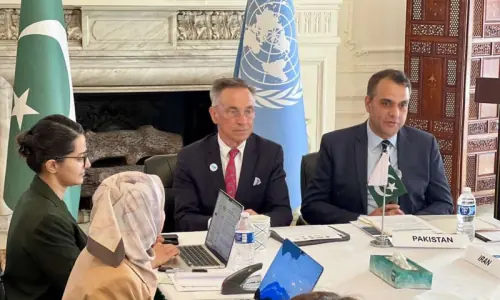
KARACHI: Not every Afghan living in Pakistan is a refugee, says representative for the United Nations High Commissioner for Refugees (UNHCR) Maya Ameratunga.
The UN representative was speaking at a group discussion about the UN’s mandated role and operations in Pakistan at a local hotel here on Monday.
The discussion mainly revolved around the repatriation of the Afghan refugees from Pakistan after a brutal attack by the Taliban on a school in Peshawar.
Also read: Footprints: The usual suspects
With a round of debates on sending the refugees back, she argued that there was no criminal involvement of the registered refugees living in Pakistan but they could not give any guarantees about the unregistered ones.
She, however, added that the UNHCR was in close coordination with the government over the issue.
Speaking in the context of Sindh, the representative informed the audience with the help of slides about the refugees presence and status and said there were 67,000 refugees in the province at present.
Their number continues to increase and decrease depending on the number of people making their way and returning through the porous border Pakistan shares with Afghanistan.
For instance, there were 72,000 Afghan refugees in the province, till last year, and by the end of this year 5,000 reportedly returned to their homes. Apart from the Afghans, the number of Somalian refugees in Karachi is around 200.
For the past 35 years, a large number of Afghan refugees have been residing in Pakistan fuelling discussions on its huge impact on the country’s already flailing resources.
At present 1.5 million refugees are in Pakistan. They were registered for the first time in 2005, 25 years after they first came to Pakistan in 1979 during the Afghanistan-Soviet War.
The door-to-door data collection put the total number of Afghan refugees in the country at three million and over the years, 1.5 million refugees have repatriated to their country.
They were soon issued the Proof of Registration (POR) cards by Nadra. Under the process the family is given a unique number. In case of married men with children under the age of five, the children’s names are then printed at the back of the card. As soon as the children reach the age of five, they have their own POR cards.
Explaining the process, public information officer at the UNHCR Duniya Aslam Khan said that the first POR cards were issued to the refugees in 2006 for a period of three years with the expectation that the situation would improve in Afghanistan during that period.
But the government gave another three-year extension in 2009 after the situation in the country (Afghanistan) further worsened. The government of Pakistan recently extended the refugees’ stay in the country till December 2015.
At the same time, she pointed out, there was no set time for the refugees to return to their homeland. “The entire process of refugees returning to their homes is a voluntary one. Pakistan still shares a porous border with Afghanistan and even if we expect them to go back, the condition on ground has not improved, especially in the east and south of Afghanistan, for the refugees to return to their homes,” she added.
Ms Ameratunga said that instead of forcing the refugees to leave, the state needed to “strongly manage its migration policy and control along the border.”
And in the meantime, she added: “We should not confuse the illegal refugees with the registered ones.”
Published in Dawn, December 30th, 2014