



 0
0
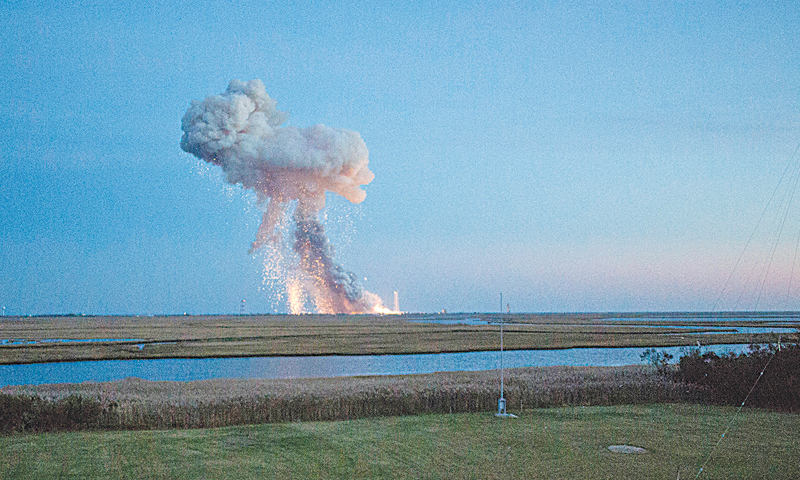

WASHINGTON: An unmanned rocket owned by Orbital Sciences Corporation exploded on Tuesday in a giant fireball and plummeted back to Earth just seconds after launch on what was to be a resupply mission to the International Space Station.
“The Antares rocket suffered an accident shortly after lift-off,” Nasa mission control in Houston said, describing the blast at Wallops Island, Virginia, as a “catastrophic anomaly”. Orbital’s unmanned Cygnus cargo ship was carrying 2,200kg of supplies for the six astronauts living at the research outpost.
After the countdown, the base of the tall, white rocket ignited on cue, then rose a short distance into the air before it suddenly exploded in a fiery blast six seconds later.
Enveloped in flames, the rocket collapsed to the ground, as a cloud of dark grey smoke rose from the wreckage.
Officials said the cost of the rocket and supplies was over $200 million, not including the damage caused on the ground.
Investigators swiftly secured the perimeter of the area and forbade any outside interviews of witnesses or staff, citing classified equipment that had been aboard the spacecraft.
As night fell, fires were seen burning at the coastal launch pad, where waves lapped at the shore. It was unclear what caused the explosion. “Something went wrong, and we will find out what that is,” said Frank Culbertson, executive vice president at Orbital Sciences. He said investigators would evaluate the debris and analyse the rocket’s telemetry to uncover the exact sequence of events.
All personnel in the area were accounted for, and there were no injuries, officials said. There was, however significant property damage at the site. It was the first night-time launch of an Antares rocket, according to Orbital’s pre-launch blog. Engineers said the countdown had gone smoothly, and there were no issues apparent with the machinery before the launch.
“We don’t really have any early indication of what might have failed,” Culbertson said.
The mission, known as CRS-3, was to be Orbital’s fourth trip to the ISS, including an initial demonstration flight.
Bill Gerstenmaier, associate administrator of Nasa’s Human Exploration and Operations Mission Directorate, said the space station was well-stocked and that no “absolutely critical” cargo was lost in the blast.
Published in Dawn, October 30th, 2014





























