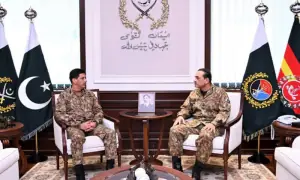
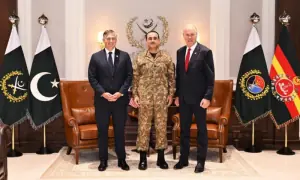
The outgoing Peshawar corps commander Gen Khalid Rabbani has spoken candidly about the national dimension of the militancy problem, squarely indicating that regions outside his operational command of Fata and Khyber Pakhtunkhwa have a potent, and varied, mix of militancy that needs to be tackled urgently.
By citing militant hotbeds in other provinces, the commander of the military’s ongoing Operation Zarb-i-Azb in North Waziristan Agency should not be seen as trying to deflect responsibility, but should be applauded for attempting to put the fight against militancy in its proper context — which means regarding Zarb-i-Azb as an important, but by no means final, step in the right direction.
Unhappily, few lessons appear to have been learned from the experience of Fata and KP, where militancy festered for years in plain sight until it exploded about a decade ago. Now for years the country has heard about a growing militant network in Punjab, Balochistan and Sindh, but for the most part such warnings have met with the same dire apathy that once greeted those about what was brewing in Fata and KP.
In many ways, the next phase of the fight against militancy — and this phase will come whether the state decides to take the fight to the militants or vice versa — presents an even bigger challenge than Fata.
That is both because the non-military tools — civilian-led law enforcement and counterterrorism forces — are either non-existent or unable to perform adequately. Moreover, the militants themselves are more integrated within society in the provinces, living, recruiting, fund-raising and contributing welfare schemes to the communities in which they live.
A bigger challenge with less effective resources to fight it — that is essentially the dilemma that militancy outside Fata and KP presents. Yet, Gen Rabbani left a few things unsaid and they concern his institution. For one, while highlighting the need for so-called intelligence-driven operations requiring cooperation and coordination among a host of provincial, national, military and civilian agencies, Gen Rabbani left unsaid what the eternally fraught civil-military relations, especially in light of recent events, have done to the possibility of cooperation and coordination.
For another, has the military leadership really dropped the idea of a distinction between good and bad militants across Pakistan? Operation Zarb-i-Azb itself has left a question mark over whether that is truly the case. Surely, the civilian-led dispensation must perform better. But can it if the old power centre is still unable to fully move on?
Published in Dawn, September 26th, 2014