4
4


The government seems to have been betraying its commitments to stamp out torture apparently due to the political interference in the appointments of police officials on important posts.
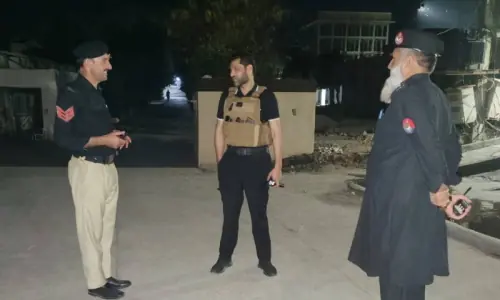
In a recent case, a large number of people from Kotli Sattian attacked the local police station, tortured the police officials and blocked the traffic on main road for over six hours. They were protesting obnoxious remarks allegedly passed by the SHO about a family while settling a dispute between two groups.
In return, the police rounded up several people, suspected to be involved in torturing the police officials and attacking the police station, and reportedly subjected them to inhumane treatment. The tension is yet to settle as people have given a deadline to the police to mend their attitude.
The second incident came to light in an urban area police station, where a detainee was tortured for signing a confession that he was involved in a car theft. Ultimately, the detainee died in the police custody, which was acknowledged by the police when it registered a murder case against eight police personnel.
Torture is routinely used as a means of extracting “confessions” by the police. The detainees are beaten, knotted in painful positions, suspended from ceilings to make them confess that they were involved in a crime.
Said Khan, a resident of Mohmand Agency who was accused of car theft, didn’t confess to the alleged crime despite all cruel tactics used by the police of the two police stations – Airport and New Town – until he lost his life.
During the investigation, two of Khan’s accomplices allegedly confessed to stealing two cars. The Airport police, however, was unable to make Said Khan confess to the crime. This is when the station house officer of the New Town asked his counterpart to hand over the accused to him, claiming he could get the confession from him.
“While being subjected to torture, his blood pressure started dropping and he could not recover,” a police official at the New Town police station said about Khan, who was investigated in the presence of the SHO. A superintendent of Rawalpindi police was also allegedly in the loop about the investigation.
On seeing his condition deteriorating, the Airport police officials were called and asked to take their accused back. While the Airport police were taking the torture victim, he died.
A medical board carried out the postmortem on the body of Khan. Though its final reports are awaited, torture was confirmed in the murder case registered against the eight police personnel with the Airport police. However, two of the policemen booked in the torture case are yet to be arrested.
Human rights activist Tahira Abdullah condemned the police torture during which a man, who was yet to be proven guilty, was killed.
“The police men involved in the murder must be punished with full force of the law, though the court,” she said and added: “Recruitment and training of police force in Pakistan needs to be improved, if the people are to be protected from police brutality.”
The Model Town incident in Lahore, in which precious lives were lost, was an evident of Chief Minister Shahbaz Sharif’s soft corner for the police. Now, the PML-N central government has to use the police force to foil ‘Azadi March’ of Pakistan Tehreek-i-Insaf and Tahirul Qadri’s movement against the existing corrupt system – whether they are right or wrong.
The question here is why the CM will bring the existing police lot to justice when he badly needs such people to suppress his political opponents.
In such circumstances, the Model Town incident, public reaction against Kotli Sattian police, torturing of detainees by police and serious complaints by public and senior police officers could be very minor things for Shahbaz Sharif and his party leaders to make them realise that the police will not help them when they will be in trouble.
Published in Dawn, August 9th, 2014