4
4


KARACHI: Offering more varieties, designs and competitive prices, locally manufactured children’s garments have reclaimed the market share as the demand for Chinese clothing items falls.
People on a tight budget prefer buying cheaper goods as opposed to expensive imported ones and hence, for them ‘Made-in-Pakistan’ products are a blessing.
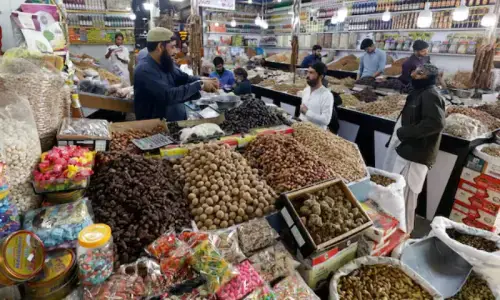
Garment stalls selling inexpensive children clothing are present in almost every market. With Eidul Fitr around the corner, sales are brisk as people like to buy new dresses for their children even if their budget forces them to compromise on the quality.
A locally produced girl’s frock is available for as low as Rs250 at road side stalls as compared to Rs1000 and above in shops dealing in imported children wear.
Talking to Dawn, Pakistan Readymade Garments Manufacturers and Exporters Association (PRGMEA) South Zone Chai-man Arshad Aziz said that some five years ago, imported children’s garments including those from China, Thailand, Vietnam etc occupied 75 per cent market share which has now dwindled to 50pc at max.
“However, the share of Bangladeshi children garments has increased to as much as 25pc from zero some years back. Bangladesh is procuring yarn/fabric from Pakistan and India and re-exporting it to Pakistani markets,” he added.
He attributed the falling share of Chinese garments to rising prices triggered by high cost of production and labour charges.
Arshad said that in cotton category Pakistani garments have no match with Chinese or imported garments. However, in synthetic and nylon, Chinese products are still much better in terms of prices.
He said that under invoicing and smuggling of children garments is thriving which needs to be curbed for the protection of local industry.
President Karachi All Tajir Itehad (KATI) Atiq Mir was of the view that Chinese and other imported garment now hold 30-40pc market share in children garments as compared to 70pc share some five years back.
He said garments produced by the local industry are now much competitive than imported and Chinese garments.
“Our local industry is continuously gaining its market share due to improved quality, competitive prices and rising trend of wearing readymade garments,” he added.
The KATI chief said that costly Chinese brands are usually found in big stores and commercial centres but local garments virtually rule the local markets.
A number of people have set up stalls in the markets selling majority of locally produced cheap garments instead of Chinese brands.
A good quality Chinese T-shirt or shirt for kids available at big stores cost at least Rs900-1,200 depending on the quality. Similarly, trousers’ prices also hover between Rs1,100 and Rs1,500.
Some Pakistani branded garments made of cotton are also costlier than Chinese.
In contrast to decline in demand of foreign readymade garments, a number of low priced shalwar kameez makers are using 30-40pc low price Chinese fabric for making readymade shalwar kameez. For 100 per cent cotton suits, they are procuring cotton fabrics from local mills.
According to figures of large -scale manufacturing, production of cotton cloth inched up to 949,500,000 square metres in July-May 2013-2014 as compared to 943,070,000 square metres in the same period last fiscal year.
Published in Dawn, July 25th , 2014