0
0

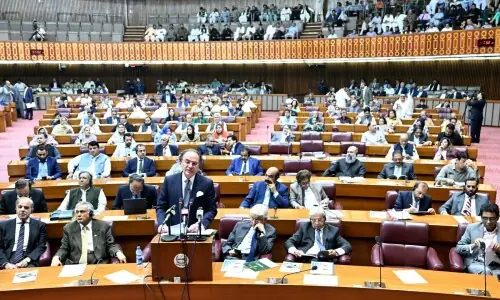
BAGHDAD, July 13: A US-backed Iraqi Governing Council held its inaugural meeting on Sunday, stressing the start of a new era by abolishing national holidays that honoured Saddam Hussein and creating a new one to mark his downfall.
The 25-member interim council has the ability to appoint ministers, approve the national budget and review laws, although ultimate authority remains with the occupying powers that have ruled Iraq since US-led forces toppled Saddam on April 9.
“Saddam has been tossed into the rubbish bin of history and will not be coming back,” said Mohammad Bahr al-Uloum, a Shi’ite cleric and council member, many of whose relatives were killed by Saddam’s government.
“There are defining moments in history and today, for Iraq, is definitely one of them,” Sergio Vieira de Mello, the United Nations Special Representative for Iraq, told the council.
It remains to be seen whether ordinary Iraqis think the council can represent their interests, though it does roughly reflect Iraq’s religious and ethnic composition, giving Shi’ite Muslims a majority in contrast to their position under Saddam.
Saddam and most members of his elite were Sunni Muslims who marginalised the traditionally under-privileged Shi’ites.
As the council met in a government building in Baghdad, the US military said it had launched “Operation Ivy Serpent” to prevent militants staging anti-American attacks on upcoming anniversaries linked to Iraqi nationalism and Saddam.
The new council is composed of 13 Shi’ites, five Sunni Arabs, five Kurds, an Assyrian Christian and a Turkmen. Three members are women and 16 have either returned from exile or were in an autonomous Kurdish area outside Saddam’s control.
“The launch of the governing council will mean that Iraqis play a more central role in running their country,” US administrator Paul Bremer said in a statement late on Saturday.
The administration sees the formation of the council as a first step on the road to democracy for Iraq. Further down the road lie the drafting of a new constitution, to be approved by a referendum, and finally free elections.
Bremer, who attended the meeting, said the council would bring together for the first time in Iraq’s history “a balanced representative group of political leaders from across this country”.—Reuters