0
0

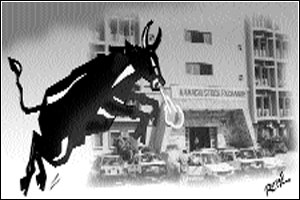 The great game of stocks is rolling on. On top of the 112 per cent gain in 2002, the key KSE-100 index has climbed another 32 per cent in the first six months and 10 days of the current calendar year—outperforming all regional markets except perhaps Thailand, which is slightly ahead.
On the back of overflowing liquidity and comparatively higher yields, the stock prices are racing north. The index level of 4,000 points which seemed a distant dream when the fresh rally began in April, is now just a stone’s throw away. Even when the prices have risen to dizzy heights, brokers are putting up ‘buy’ signs. It is possible to view them with skepticism for stock brokers’ livelihood depends on selling optimism. But these are possibly one of those rare moments in the history of country’s capital markets, when it is difficult to spot an occasional bear. So why is everyone so bullish on the market?
Stellar corporate earnings; higher dividends; continued drop in long term interest rates; expectations of economic growth and possible settlement of external and internal political issues, are cited by most market gurus as the reasons for the high flying stocks. But in the last resort, it is liquidity and high yields that are at the back of stock market boom. Post Sept 11, 2001, there has been a massive inflow of capital.
Owing to a favourable balance of payments, there has been decrease in public borrowing from financial institutions, which is why interest rates have seen sharp plunge.
The SBP has been taking measures to stabilise interest rates and rupee exchange rates by absorbing liquidity through open market operations (conducting T-Bills auctions and buying US dollar from open market). Lower interest rates, have in turn, enabled corporates to post huge earnings growth, by enabling them to restructure costly debts.
It would be unfair not to give the corporate regulators their due credit for the market boom. Regulatory measures taken over the last few years has resulted in a market of visible integrity and transparency in terms of price discovery and trade settlement, which has increased investor confidence.
Reconstitution of the bourses’ boards, the circuit breakers and the code of corporate governance have all helped to make the corporate sector look tidier. Due to reform measures, there are scant fears of a recurrence of the settlement crisis that had gripped the stock market in 2000 or the badla crisis of 2001, although badla investment has risen to over Rs 12 billion, with the COT rates at around 14 per cent.
Total number of shares traded on any single day, has also increased by a significant 80 per cent during the on-going year and as investors turned their attention to second and third tier scrips, the average number of companies traded also increased from 227 last year to 335 in the current financial year. Yet, perhaps the most valid criticism on Pakistan’s capital market is its lack of depth.
Nearly 60 per cent of the entire trading volume takes place in top four volume scrips: Hubco, PTCL, PSO and Sui Northern. But unlike the last memorable rally in 1994, when scores of companies had lined up to enter the capital market, none of the 40,000 private companies are coming forward this time with an Initial Public Offering (IPO) to take advantage of the bullish fervour. Besides, the advantage of raising low cost funds from banks, corporates are also pushed away by the loads of new responsibilities placed on them under the code of corporate governance.
Foreign investors are also conspicuous by their absence. International fund managers, though, are understood to be peering at their radar screens, yet again on the distant spot, where once almost a decade ago they had burnt their fingers.
The overseas fund managers had then come in to the Pakistan’s equity markets to explore the new south Asian market that had thrown open its doors to foreign investors and where stocks looked to be trading at incredibly low single digit multiples. Foreign funds aren’t yet known to be coming back in droves.
Foreign portfolio investment actually recorded net outflow of Rs 1.46 billion in the first seven months of the current fiscal year. But many stock gurus believe that as the market capitalisation, which currently is US $ 14 billion, hits the $20 billion mark, there may be a rejuvenation of foreigners’ interest in the Pakistani stocks.
No one is willing to hazard a guess on high the equities would fly. Market prices of top-tier scrips are nowhere near their historic best. Consider some of the examples: Adamjee Insurance had hit Rs 460 in 1994; it is now trading at Rs 67. Other comparative values of the great bull run of 1994 and now are: Engro: Rs 350 and Rs 88; Fauji Fertiliser: Rs 116 and Rs 93; Cherat Cement: Rs 172 and Rs 35; D.G.Khan Cement: Rs 125 and Rs 30 and Maple Leaf Cement, which had risen to the dizzy level of Rs 306 in 1994, has now made to the value of Rs 16. PTCL, which is now at Rs 30 had made its record best in 1996-97 at Rs 45; PSO was at its highest Rs 500 in 1997; it now trades at Rs 235 and Hubco saw its historic highest at Rs 63.50 in 1998; the scrip is now doing at Rs 38.
The KSE index is trading on price-to-earnings multiple of 8.6 on financial year 2002 earnings, which is still cheaper compared to other regional markets. And some of the top-tier blue chips, though down from 14 per cent early in the year, still offer yield of around 10 per cent. Add to that the capital gains of 26 per cent and the returns put into shade every other investment option: The PIBs, TBills, National Saving Schemes (NSS), bank deposits, gold and the real estate; the last possibly receiving the second best investor response. By contrast, the 10-year PIB is offering a yield to maturity of only 5 per cent.
Institutions are flush with excess liquidity. An indication was provided on Wednesday’s T-Bill auction when, against its target of Rs 70 billion, the central bank received Rs 150 billion worth of bids, notwithstanding that the yield on the 3-month paper was as low as 1.65 per cent. SBP mopped up around Rs 75 billion.
“That means Rs 75 billion excess liquidity is still in the market and a lot of it could go into stocks”, commented a market analyst. Historically, too, institutions begin taking fresh positions in stocks with the beginning of the new financial year on July, 1,
For individual investors, the relevant yield comparison is with certificates under the National Savings Schemes. The rates of returns on NSS are being consistently lowered, every six month; the last reduction having been made on July 1. But while opting to shift investment from safer fixed income securities to second and third tier stocks, the rule of ‘buyer beware’ prevails.
There are indications that unsuspecting retail investors, who are heading to the stock market for the first time to dabble in shares, are being led astray by shrewd market players into investing in worthless scrips on such sectors as modaraba, leasing and textile.
Unless such investors tread carefully and avoid scrips of companies with negative equity on their books, in the long term, such investors are almost sure to come to grief.