Akram Sheikh has been around in the country’s courtrooms and corridors of power for so long as to have made his political and personal predilections and prejudices well known. Yet members of the superior judiciary are finding it difficult to rule where his likes and dislikes lie. Two courts in the past four months have employed rules and regulations to avoid doing that.
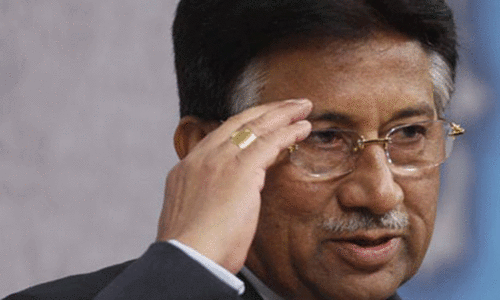
When on Dec 23, 2013, retired General Pervez Musharraf’s lawyers moved the Islamabad High Court against Sheikh’s appointment as prosecutor in the former strongman’s trial for high treason, their plea that he was biased was instantly rejected. They were raising the issue at the wrong forum, the judge hearing the case declared.
When on Friday the special court set up for Musharraf’s trial rejected a similar petition, the argument was the same: the court did not have the mandate to adjudicate on the subject.
Given the sensitive nature of the case, it would be ill advised to conjecture why the courts appear to be skirting around the issue. However, Sheikh’s long journey from a small town, Burewala, in Punjab’s Vehari district, to the centre of the most important case in today’s Pakistan, leaves little doubt about his political affiliation.
Since the early 1990s, Sheikh has represented Prime Minister Nawaz Sharif and his family in numerous criminal and constitutional cases. The latest such case was a constitutional petition in the Supreme Court early 2009 which led to the removal of the bar against Sharif’s participation in electoral politics.
At an earlier hearing of cases on the same issue at the Lahore High Court, Sheikh took up a fight with a judge while pleading Sharif’s cause. “If you shout, I will shout too,” he is reported by this newspaper as telling the judge on June 23, 2008.
In 1993, Sheikh was among the lawyers who represented Sharif when he challenged the dissolution of his government. He also successfully defended Sharif’s Punjab government’s right to open its own bank during confrontation with Benazir Bhutto’s federal government in 1988-89.
Sheikh, however, had a brief estrangement with Sharif in 1997-99. At the time, he supported the then Chief Justice Sajjad Ali Shah against Sharif and opposed the government’s decision to set up military courts for trial in terrorism cases.
Many say the differences between the two were personal as quite a few people close to Sharif did not like Sheikh. His son, Raheel Kamran Sheikh, disagrees. “One of the main reasons for their differences was the Shariat Bill that Sharif wanted parliament to approve and which my father could not support,” recalls Raheel, who is also a lawyer.
Just before those years, Sheikh had served as the president of the Supreme Court Bar Association. “Both the bar and the bench were unhappy with the Sharif government in 1997-98. [My father] could not ignore the imperatives of lawyers’ politics for the sake of power politics. Being a prominent representative of the bar, he could not remain aloof,” says Raheel.
Indeed, bar politics is the reason why Sheikh came close to Sharif in the first place. When Sharif, as chief minister of Punjab, came to visit Multan in 1987, Sheikh was the president of the High Court Bar Association, Multan. “Sharif always thought having support among lawyers was a good way to enhance his popularity,” is how Raheel explains his father’s initial proximity with Sharif.
Others say it was Javed Hashmi who brought Sheikh into Sharif’s camp.
All his life, it seems, Sheikh has made little effort to hide his ideological and political affiliation. One of his most important cases in the recent past is the hearings over a memo allegedly written by Pakistan’s former ambassador in Washington, Husain Haqqani.
In that case, Sheikh represented Mansoor Ijaz who alleged that Haqqani had written the memo on the advice of then president Asif Ali Zardari calling for American help against Pakistan military’s intervention in politics.
In his appearances on television shows during those days, Sheikh would say exactly the same things that the military leadership was saying about the case. That makes one thing clear: Sheikh is not opposed to the institutional interests of the military.
Do those interests demand that Musharraf be not tried? Sheikh clearly thinks otherwise, since he has always forcefully and publicly argued about trying the former dictator for treason. Does that stem from his personal bias against Musharraf? After all, the former general treated Sheikh’s political leader, Sharif, quite shabbily.