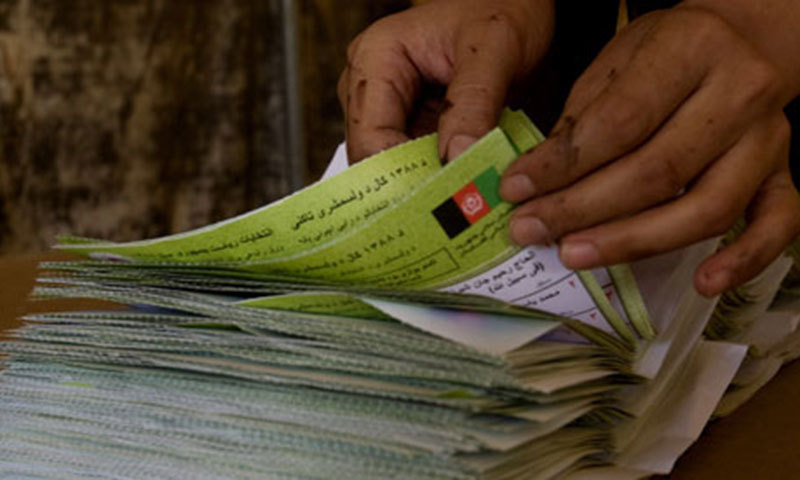
There is a campaign poster glued to the wall at the back of the counter at NTR Printing Press where Maqbali Khan sits relaxed, smoking a cigarette on a quiet Sunday morning. It is one of several, printed for candidates of Afghan provincial councils contesting the April 5 presidential and provincial council elections in Afghanistan.
The poster promotes a woman candidate in Takhar, a province north-east of Afghanistan, bordering Tajikistan. “Raza-i-Khudawand raza ma ast, Quran qanoon ma ast”, is the candidate’s rallying cry inscribed in red, at the top of the poster. At the bottom, it says: printed at Ariya Matiba, a printing press in Jalalabad, Afghanistan.
Except it is not. The poster, and many others for candidates in Afghanistan’s presidential and provincial council elections, is printed at the printing presses in Peshawar. Hopeful faces of Afghan election candidates look at passers-by from shop fronts and walls all over the narrow, paper-littered street of Jhangi Mohallah. If one didn’t know better, one would be forgiven to believe that this is a street in Afghanistan, caught up in campaign fever, its inhabitants rooting for their favourite election candidates.
The posters with Afghan candidates — bearded, shaved, turbaned and, in the case of women candidates, draped in the modest halo of a shawl — offer an interesting insight into the presidential elections where scholarly politicians have partnered with former Jihadist warlords in a bid to win over the ethnically divided electorate.
Competing for the presidential post are eight candidates. The number of candidates for provincial councils runs into hundreds. In terms of campaign funding, that translates into big money. According to the Afghan news network, ToloNews, campaign material printed abroad for the 2009 presidential elections cost a whopping $20m.
After the election campaign kicked off on Feb 2, the Afghan Industrial Union (AIU) criticised candidates for printing campaign material abroad, especially Pakistan. Other countries claiming a share of the printing pie are Iran, India, China and the United Arab Emirates. According to ToloNews, there are 130 printing agencies in Kabul but “the demand for these agencies is not nearly as high as that of Peshawar’s”.
“The Afghan government has asked candidates not to publish campaign material abroad,” says Khan, exhaling curls of smoke into the cool, damp air of his office. His press is one of the 1,800 printing presses — with some 20,000 workers — jostling for space in the narrow Jhangi Mohallah in Peshawar. “The printing businesses in Afghanistan outsource because they don’t have the capacity to print huge orders.”
Printing campaign materials in Peshawar makes economic sense for the candidates and the canvassers — locally called “convincers” who are local or Afghan commission agents that secure orders in Afghanistan to print here. They have to pay in Kaldara (Afghan Pashto for the Pakistani rupee) rather than in the Afghani, stronger than the Pakistani currency in terms of exchange value in dollars.
Also, there are some four thousand printing presses in Jhangi Mohallah and Dhaki Nalbandi — another street nearby — together and competition reduces cost without compromising quality.
“The profits go to those who bring the business,” says Zahid Hussain, 38, owner of the Zahid Printing Press. “We only got 10 per cent of the business this time, the rest stayed in Afghanistan due to their government policy to discourage printing abroad. We have heard the Chinese, Iranians and Indians have set up printing businesses there.”
Printers in Jhangi Mohallah, including the mild-mannered general secretary of printers’ union, Raja Saeed, echo Hussain’s opinion. Having reaped windfalls during the 2005 and 2009 elections in Afghanistan when most of the campaign materials were printed here with workers staying up all night to deliver orders, they blame the Afghan government decision to invest in domestic printing industry for their reversal of fortune.
Over the years, trained workers from Peshawar and Lahore have moved to Afghanistan when opportunity beckoned. For handsome pays, they helped establish printing businesses owned by Afghans with their art and technique. These businesses now compete for share in a business that was once entirely the preserve of printing presses in Peshawar — from religious books and NGO publications to official and election materials. It helps that the donor community and the Afghan government favour local businesses to strengthen them.
“In 2005 when the first presidential elections happened in Afghanistan, we worked like it was local elections,” says Saeed. “We were engaged at all levels of work — printers, designers, plate makers, film printers, labour and transporters. Back then the candidates would come here to order in person, now we only get commission agents. When they take back the orders, they are harassed by the Afghan border guards.”
With only four days to go before Afghan presidential elections, the press machines in Jhangi Mohallah have fallen silent, hulking in the shadows of ill-lit basements, ground floors and top. A labourer heaves to tighten the knots on last of the orders, cartons full of campaign cards for the presidential candidate Abdullah Abdullah. The card promises reform that has long eluded Pakistan’s war-wracked western neighbour.