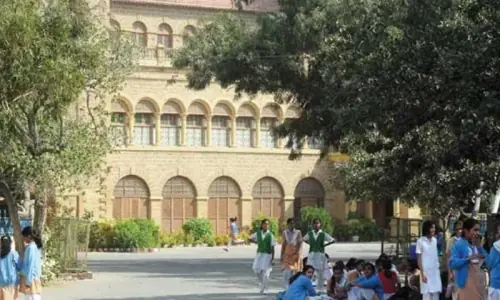
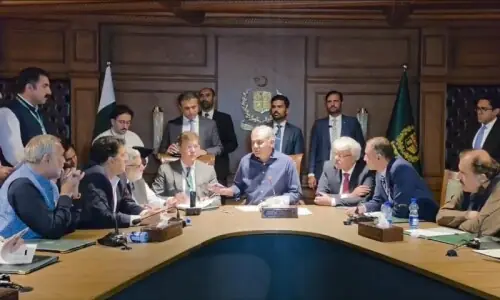
KARACHI: Persistent and emerging challenges to promoting gender equity in educational settings in Pakistan were examined at the Policy Dialogue Gender Equity in Schools organised by the British Council at a hotel on Tuesday.
“After imparting basic education to females, if you don’t take them further, there is this frustration like ‘what to do now when we know how to read and write’,” said Zubaida Jalal during a panel discussion on ‘Gender-sensitive and discrimination-free practices in education that work in Pakistan’ moderated by Prof Dr Bernadette Dean, director of the VM Institute for Education.
“Things can happen if there is a will. People are demanding more education and hence the challenges for the government. Eighteen per cent of the GDP in Balochistan has been allocated for education and there is another 20pc for taking it to a higher level,” she said. “Information technology and mobile phones can provide links and connections but the policies have to be remade in order to cater to nomadic lifestyles as Balochis are in the habit of moving from one place to another in pursuit of favourable weather. Then there are also emergencies such as earthquakes and floods that can also affect education in the area,” she said.
Ghulam Sarwar from Azad Jammu and Kashmir was of the opinion that in their region they felt that they could reach their aims in education by mobilising the community.
Azmat Siddiqui of the directorate of staff development in Punjab said that they had to keep track of students’ performances to see how the teachers were doing. “When political will comes behind you it pushes you forward,” he said.
In the next panel discussion on ‘Gender-sensitive and discrimination-free practices in education that work from around the world’, also moderated by Dr Dean, there were participants from Scotland and Bangladesh.
Dr Barbara Read of the School of Education in Glasgow said that they looked at how to make their curriculum gender-sensitive while also studying the students’ different ways of learning, teachers’ perceptions and teacher-student communication. “We also carry out gender awareness and training for teachers, rewrite traditional fairytales and write about girls’ experiences,” she said.
David Watt, also from Scotland, said that women were the ones who really drove their teaching force. He was also pleased to share the fact that girls in Scotland from Pakistani background outperform others in their schools.
Prof Dr Abdul Mansur Ahmed from the University of Dhaka pointed to having the same language and no confusion about medium of instruction in schools and no ethical clashes in their country to the good attendance of females in their secondary schools. “We have already met several of our Millennium Development Goals,” he added.
In her keynote address, Dr Audrey Juma, director of the Notre Dame Institute of Education in Karachi, said that investing in girls’ education was a step in the right direction but girls’ dropout rate was on the rise in Pakistan due to various reasons including distances to be travelled to reach schools, early marriages, housework, etc. “Girls here are not seen as the breadwinners so parents feel that they would be wasting their resources on their education. Also people have misinterpreted Quranic verses and developed wrong beliefs with regard to girls’ education,” she said.
Looking at the policies and practices aimed at ensuring that girls were treated equitably, she said, “Gender equity is important so that each individual can function to potential. France has a school policy for gender equity where the text in school books is not gender biased.”
Also, she said, school teachers should take care while using language and refrain from using words such as ‘fireman’, ‘policeman’, ‘mankind’, etc., in favour of words such as ‘people’, ‘chairperson’, etc. “To do this and other things, the teachers, too, required basic training for they may have the will but not know how to go about teaching without bias,” she said.
“We should also learn from the positive examples in other countries,” Dr Juma said.