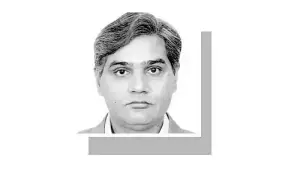
“There are almost 3,000 enrolled lawyers in Islamabad, but only some 2,000 are practicing. There are some four or five hundred enrolled female lawyers. Over 1,000 lawyers have been given small offices, or chambers, by the Capital Development Authority (CDA) in the F-8 Markaz, behind the District Court,” explains Rashadul Musawar, who is an advocate with over 10 years practice after he received his high court approval.”
“Often, I am busy the whole morning in court, when I have a case requiring my attendance. After lunch, I go to my F-8 chambers, and in the late afternoon, I move to my private office premises for further work. I have busy working days, but I like my work,” Rashad says.
“At university, I studied science subjects for my Bachelor’s degree, which is a bit unusual. Most who become lawyers take arts, literature or social sciences for the first degree. And after BSc, I did my LLB law degree in Lahore, which took three years. Today, a four-year honours degree has become common,” he says.
“As a lawyer, one deals with cases in many fields. Most of the clients can pay, but not all. Just now, I am handling a serious criminal case for a woman who has been given bail without having to pay. And I do the job for her without any charges.”
“Family law is a growing field. There are many family disputes and an increase in the number of female clients, in line with the modern times. And many women would also hire women to represent them,” says Rashadul Musawar.
“I was a secondary school teacher almost for 10 years before I took up my law studies,” says Idrees Ashraf, who is a lawyer in Sajjad Associates in Islamabad, a prestigious firm in town.
“I don’t regret that I changed profession,” Idrees says. “And I was lucky to get into a good firm only a few years after I received my LLB, much thanks to barrister Saadia Abbasi, who is a former senator and a member of the academic council of the Institute of Policy Studies (IPS) in Islamabad.”
“It is true that to get into the law profession and get good clients, it often depends on the environment you live in and the contacts you have,” Idrees says.
“But as in other professions, the most important attributes to become a good lawyer is to be honest and hardworking. A lawyer must be imaginative and see issues from as many angles as possible. He or she must think independently. Intelligence as such doesn’t really cover all aspects of what we are talking about. It must be given a very broad definition, and it also includes common sense.”
“Furthermore, it is important that a lawyer is matriculate and accurate. And that demands quite a bit of patience,” Idrees says.
His young colleague Barrister Mohammad Hassan Alam, who sits next to him in their good and newly renovated chambers, agrees. He is busy looking up something on Internet. And he mentions that the new tools are important for modern lawyers, for example, when comparing cases from elsewhere.
“In Pakistan, it is common to study cases from India,” Hassan Alam says, pointing at the hundreds of bound books on huge shelves behind him.
Hassan did his LLB from London as an external candidate living in Islamabad. After that he did his six months practical training, called pupilage for lawyers, and a diploma to qualify as a barrister.
“But in the UK, one can start law studies directly from upper secondary school, or A-level. One doesn’t need to have what one in Pakistan and many other countries call a double Bachelor’s degree.”
“In many countries, lawyers often give reference to the Constitution of the land, for example, in the US where it is often used to block change. In Pakistan, we also do that frequently,” says Ali Sajjad, “too frequently”, he adds.
“However, it is necessary to have a basis for the law of the land, so a Constitution plays an important role, whether it is written, or it is based on convention and practice, such as in the UK.”
“Pakistan’s Constitution is from 1973, but many amendments have been made, requiring two-thirds majority in both houses of Parliament. The largest amendment, the Eighteenth Amendment, made in 2010 included changes to about half of the articles of the Constitution. And after that we have also had a Nineteenth Amendment,” explains Idrees Ashraf.
“The Norwegians are very proud of their Constitution,” says retired major Mukhtar Ahmed, just back in Rawalpindi from a long stay in Norway, where his brothers and cousins live.
“This year, Norway celebrates the two-hundredths anniversary of the Constitution, one of the oldest in the world.
“But, of course, it has been amended so many times that it may not really be quite correct to refer to it as being from 1814. Yet, a celebration also marks the country’s modern history and it emphasises the birth of the land, its democratic traditions and the rule of law.”
“We should note that to be a lawyer, to argue cases in court or find amicable solutions to disputes out-of-court is not only based on the Constitution and all the other laws of the land, it is also based on politics and what we see as politically correct and fair at any given time.
“The Constitution has been subject to 19 major amendments, and often without enough consultation and debate,” says Tahir Hussain Lughmani, a senior advocate Supreme Court, working in Haripur, Mansehra and Islamabad.
“Laws, statutes, rules and regulations are often based on group interests and the majority’s decisions. They may not be seen as fair by all, but must still be followed by all,” says Tahir Lughmani.
“I don’t like the term Islamic or Sharia laws. Such laws are laws like any other laws,” he says.
“But it must be stressed that laws should generally be built on general consensus; they should be acceptable to most or all people in a society in question, and we should always work to improve the laws that regulate people’s lives,” says Tahir Hussain Lughmani.