0
0
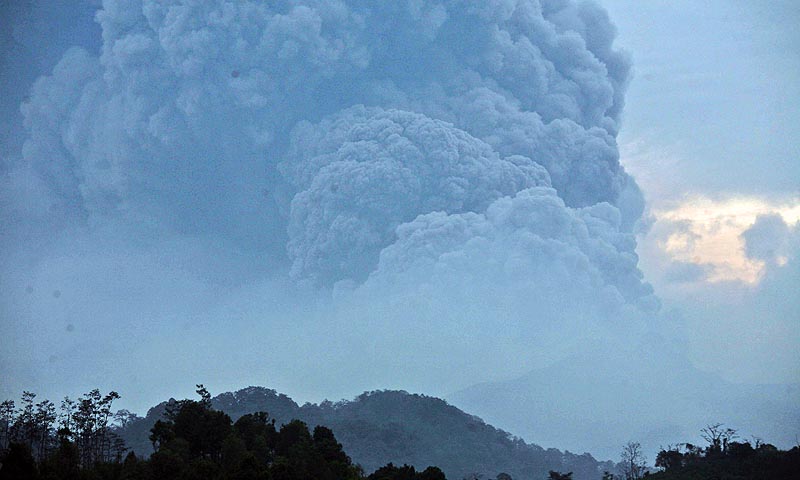
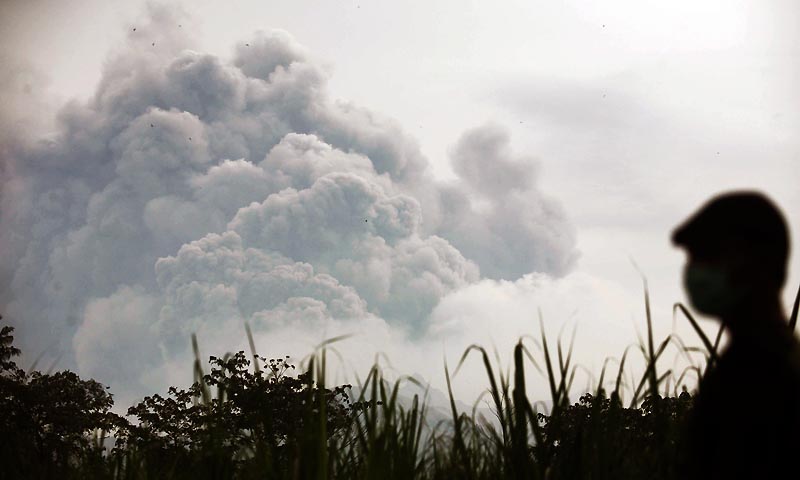


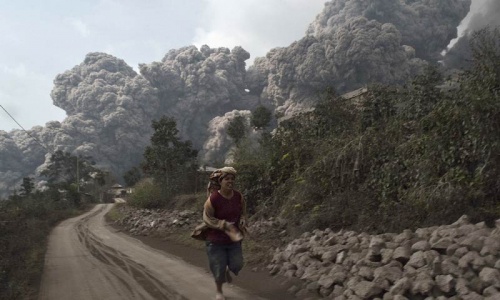
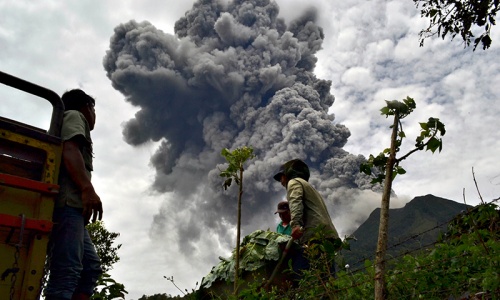
SURABAYA: Volcanic ash from a major eruption in Indonesia shrouded a large swath of the country's most densely populated island on Friday and closed three international airports.
Local media reported two people were killed when parts of their homes collapsed after Mount Kelud's explosive eruption overnight.
The initial blasts sent millions of cubic meters of dust and rocks into the atmosphere, according to the country's disaster agency, and could be heard up to 200 kilometers away.
Ash up to an inch deep covered Surabaya, the country's second-largest city, and even farther afield in Jogyakarta, where motorists switched on headlights in daylight.
TV footage from towns closer to the peak showed cattle covered in ash.
Transport Ministry spokesman Bambang Ervan said Jogyakarta, Solo and Surabaya airports were closed due to reduced visibility and the dangers posed to aircraft engines by ash.
The country's disaster agency said tremors were still wracking the volcano, but scientists didn't expect another major eruption.
It said many of the 200,000 people living within 10 kilometers of Kelud who had evacuated returned to their homes to begin cleaning up.
The 1,731-meter Kelud in the east Java, home to more than a half of Indonesia's 240 million people, has been rumbling for several weeks and was under close observation.
Muhammad Hendrasto, head of the country's volcano monitoring agency, said the mountain erupted violently about 90 minutes after authorities raised its alert status to the highest level.
Kelud is among about 130 active volcanoes in Indonesia.
The archipelagic nation is prone to volcanic eruptions and earthquakes because of its location on the so-called ''Ring of Fire'', a series of fault lines stretching from the Western Hemisphere through Japan and Southeast Asia.
Due to the fertile volcanic soil and the shortage of space on Java, hundreds of thousands of people live close to active volcanos.
They are used to the rumblings, but their proximity to the peaks presents difficulties for authorities.
The last major eruption at Kelud was in 1990, when it kicked out searing fumes and lava that killed more than 30 people and injured hundreds.
In 1919, a powerful explosion that reportedly could be heard hundreds of kilometers away killed at least 5,160.
Earlier this month, Mount Sinabung in North Sumatra province erupted as authorities were allowing thousands of villagers who had been evacuated to return to its slopes, killing 16 people.
Sinabung has been erupting for four months, forcing the evacuation of more than 30,000 people.