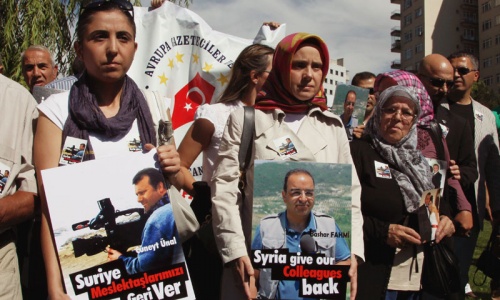
BRUSSELS: Some 108 journalists and media professionals were killed around the world doing their jobs this year, with conflict-torn Syria the deadliest country ahead of Iraq, the International Federation of Journalists said Tuesday.
The death toll is down 10 per cent from 2012 but the IFJ said governments still need to do more to “stem the bloodbath in the media”.
“Levels of violence are still unacceptably high and there is an urgent need for governments to protect and enforce journalists' basic right to life,” it said in a statement.
The group issued what is said was a “desperate appeal for governments across the world to end impunity for violence against journalists and media staff”.
The IFJ listed Syria as the most dangerous country with 15 journalist deaths, followed by Iraq on 13, Pakistan, the Philippines and India with 10 each, Somalia seven and Egypt six.
By region, the Asia-Pacific was the worst, accounting for 29 per cent of the deaths, and the Middle East and Arab world 27 per cent.
The IFJ, which represents more than 600,000 journalists in 134 countries according to its website, said female journalists were facing increased levels of violence.
Six were killed in 2013 and many others were the victims of sexual violence and intimidation, it said.
Earlier this month, media rights watchdog Reporters Without Borders said 71 journalists were killed in 2013, down slightly, but kidnappings rose sharply.
The IFJ figures include media workers such as film crew and presenters.
Separately, the Vienna-based International Press Institute put the number of killed journalists so far this year at at least 117, making 2013 the second deadliest year on its Death Watch since it started counting work-related journalist deaths in 1997.
It said the Middle East and North Africa were the deadliest regions, with 38 deaths overall.
The worst year was 2012, with 132 journalists killed, 39 of them covering the Syrian conflict, the IPI said.