Islam, democracy and modernity
SINCE most Muslim countries have authoritarian governments, it has become part of the academic discourse that Islam is not compatible with democracy and modernity. Also, many still believe that Islam divides the world into Darul Islam (Muslim-ruled) and Darul Harb (to be conquered) lands.
On the Internet, too, this discussion goes on and Islam is believed by many to be undemocratic and anti-modernity. To a great extent what happens in the Muslim world is responsible for perpetuating such a discourse. Many Islamic theologians, too, hold that Islam and democracy do not go together. Maulana Maudoodi had coined the term ‘theo-democracy’, that is to say that Islamic democracy would be basically theological in content because parliament in an Islamic country cannot legislate Sharia laws; it can legislate only in administrative and subsidiary matters.
As for theologians believing in Darul Harb and Darul Islam, the terms find no mention in the Quran or Hadith. It was a juristic opinion in an age when the nature of polity was very different. Under an authoritarian monarchical rule there was no concept whatsoever of basic rights or freedom of conscience. Yet, perhaps Islam was the first religion whose scriptures clearly proclaimed the doctrine of freedom of conscience (2:256).
After Islam entered the feudal age under the Umayyad rule, democratic values were lost and could not be re-appropriated. This is sadly true to date. However, the fact is that Islam is not at all incompatible with democracy. What has been going on in Muslim countries (are they really Islamic states?) cannot determine what Islam really dictates. The lack of democracy in the Muslim world is an empirical reality. It is not due to the Islamic ideological doctrine. It is the conservative elements who feel insecure by any kind of change in social and political structures; thus, they rely on such formulations.
Another scholar of Islam who studies the revealed scriptures may not find any such formulations in them. The Quran, as pointed out by many scholars, does not give any concept of a state. It gives only the concept of a desirable society — a just, exploitation-free society, which may translate into a state.
The early caliphate depended on Muslim opinion and was quasi-democratic in nature. It did not last more than 30 years, and was replaced by dynastic rule, followed by other dynasties. A caliph could not be installed through dynastic rule, which is what happened and was an aberration. The caliphate ceased to be an Islamic system and retained itself only in name. How then can Islamic teachings be blamed for what happened in history? History of any faith’s adherents represents an empirical reality, which is determined by complex historical forces. Conversely, if a monarch who seized power by sheer power of the sword was accepted by conservative scholars as caliph, why can’t democracy which is based on popular will be construed as Islamic? Pray, what is it that makes it un-Islamic?
The early caliphate represented the Islamic model of government, which was far closer to democratic governance than a monarchy, sheikhhood or a military dictatorship. By merely proclaiming a state as Islamic and selectively enforcing certain Sharia rules, a state does not become Islamic. Political authoritarianism goes very much against Islamic values as embodied in the Quran and shown by the early caliphate. Freedom of conscience is the key to democratic governance, and that is why during the early caliphate even ordinary persons, including women, could freely question the ways or decisions of a caliph. This is just not possible under an authoritarian regime.
It is only the democratisation of the Islamic world which will solve the many serious problems afflicting many Muslim countries today. There are no democratic freedoms in most countries. Human rights are often not respected. Those demanding their rights are either jailed or harassed in a number of ways.
It is wrong to argue that human rights are a western concept and thus unacceptable to Muslims. Authoritarian rulers, who otherwise may support western policies and suppress popular movements, bring a bad name to this concept so that their authoritarianism is not challenged. Human dignity is the basis of all human rights, which is very fundamental to Islamic teachings. Islam is neither undemocratic nor anti-modernity.
The writer is an Islamic scholar who heads the Centre for the Study of Society and Secularism, Mumbai.
No lasting peace
THE government has entered into yet another peace deal with Sufi Mohammad’s Tehrik Nifaz-i-Shariat Muhammadi and committed itself to promulgating the Nizam-i-Adl Regulation 2009 in Malakand Division. The maulana has, in turn, promised to convince the diehard Fazlullah militia to lay down its arms and to help the government restore peace in war-ravaged Swat.
The initial response of the people of the valley has been one of jubilation at the prospect of peace after one and a half years. This is not surprising. Daily beheadings, bombardment, destruction and disruptions had paralysed normal life and given rise to feelings of helplessness and abandonment.
However, certain issues need to be highlighted. First, the assumption underlying the 17 Pata Regulations of 1974, the 1994 Nizam-i-Adl Regulation (replacing the Pata Regulations) and the 1999 Regulation was that quicker litigation would bring about ‘speedy justice’. There was a provision even in the 17 Pata Regulations for a plaintiff to have three choices for seeking redress: the jirga, the Sharia or civil courts.
More than 80 per cent of applicants applied to the civil courts. This being the case, it would be interesting to reflect on how procedural amendments would satisfy militant organisations occupying large swathes of the valley. The social impact of the regulation could well be to turn the previously tolerant society of Swat and Malakand Division into a retrogressive one with a telling impact on women and minorities. It might also deprive civil society organisations of a chance to play their due role in the rehabilitation and reconstruction of the valley.
Marginalising a whole community by promulgating a special legal package and treating it differently from the rest of the country would open several ways for non-state actors to demand the extension of the regulation to the rest of the country as calls for ‘speedy justice’ gathered momentum throughout Pakistan. The outcome will be more violence.
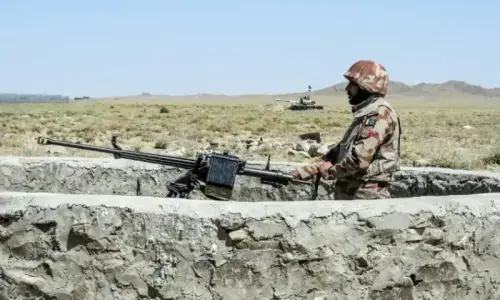
Second, the deal’s political implications are more alarming. While the provincial government had taken the responsibility for the military operation, it had no control over the operation. The military operation continued for one and a half years with heavy losses to non-combatants and infrastructure and without noteworthy successes. The military was unable to break the militant network.
The government has assumed that the deal would isolate Fazlullah from the network of militant organisations in Fata, and that, because of the promulgation of the Sharia demanded by him, he would now have little justification to continue with his violent activities. The same assumptions were at work last year when the provincial government signed a deal with Fazlullah. In fact, the provincial government came under severe pressure from the local population to express its dissatisfaction over the operation.
The deal seems to have brought the news of victory for non-state actors and of ultimate defeat for the people of Swat. Questions remain in its wake. Why have so many been killed and hundreds of thousands rendered homeless? Who would be held responsible? Will the state bring Fazlullah and his cohorts to a court of law? Will Fazlullah take back all his decrees against women, against education for girls, against polio vaccinations and against barbers’ shops?
Third, will the deal lead to some kind of strategy whereby the state can reassert the rule of law and its writ and break the rapidly spreading militant network? If the state is unable to craft such a comprehensive strategy, wouldn’t that mean that the establishment is not willing to do away with militancy and extremism?
How can the militants be restrained without an accountable military operation specifically targeting the extremists? How can support for the militants be ended without filling the structural vacuums especially in governance? How can a full-fledged insurgency in Fata, NWFP and other parts of the country be curbed without revisiting the state security paradigm?
If peace means the temporary cessation of attacks on government installations there might be some immediate political gains. But in the long run, the people of NWFP and Fata would consider this a betrayal.
The writer is coordinator for Aryana Institute for Regional Research and Advocacy.
khadim.2005@gmail.com