20
20
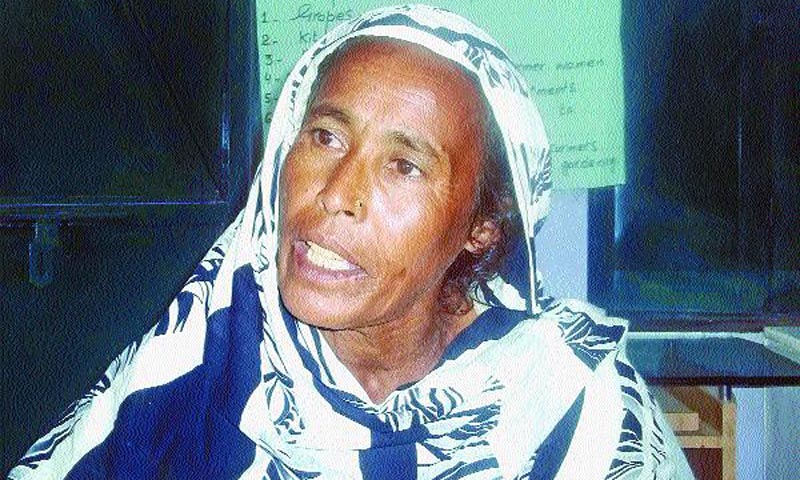

CHAKWAL: It is an account of a shattered life; a life devastated by criminals involved in women trafficking.
The year was 1978 when her husband died. Two months later, Ayesha Bibi gave birth to a baby boy in Dacca, the capital of Bangladesh. By that time her parents had already died.
Due to poverty, her relatives also gave her a cold shoulder.
She was trying to get on with life by labouring in the houses of wealthy people. But the arrival of a baby boy forced Ayesha to rethink about her financial worries.
“Someone told me that one could get a handsome amount of wage by working in Karachi and I made up my mind to migrate to Pakistan,” Ayesha Bibi recounts as she talks to Dawn in Nara Mughlan, the remotest village on the eastern side of Chakwal district.
“Taking the widowed and poor Bangladeshi women to Pakistan was a thriving business running secretly after the 1971 War,” she remembers.
Ayesha was a typical illiterate woman and vulnerable to fall prey to the traffickers. An agent of ‘women trade mafia’ assured her that he would take her to Karachi which was a ‘city of lights’ and ‘a land of opportunities’ at that time.
Ayesha, 64, does not know the name of that agent. “If you want to take your child along you have to pay Rs3,000 and if you leave the child behind I would only take Rs2,000,” the agent told Ayesha. Being a mother how could she opt for the second option? “My child was the sole ray of hope for me who could mitigate my pains and I arranged three thousand rupees in the hope of getting a new lease of life,” she stated.
As the diplomatic relations between Pakistan and the then seven-year-old Bangladesh were strained due to the 1971 war, the long journey into the lights of Karachi was to be taken illegally, keeping out of the sight of security forces of Bangladesh, India and Pakistan.
“I was not only one woman but there were many other hapless women in the convoy,” she said. Ayesha does not remember the date or month of that dark journey but she does know that they set out in the summer. “The journey was really hard as we travelled only by nights and spent the daytime by hiding in the crops of sugarcanes and cotton.” According to her, she and other women were kept on the outskirts of Delhi for six days and then reached Lahore after 10 days. “From Dacca to Lahore it took us 16 days,” she maintained.
The agent took the women to Karachi and sold them to a man whose name according to Ayesha was Shamsul Haque. “Shamsul Haq resold five of us to another person at the rate of Rs5,000 each,” she recalled.
Here entered Mirza Mohammad Hussain who belonged to Nara Mughlan village of Chakwal and was posted in Karachi as a soldier of Pakistan Army. He had lost his wife and was in search of another one. How did he reach Ayesha is a mystery but he expressed his desire of marrying her and Ayesha accepted it. “He was much older than me and was about to retire from the army but despite being young I decided to marry him as I badly needed a person who could support me,” she said.
After retiring from the army, Mirza Hussain joined a private organisation and served there for a few years. The couple, including Ayesha’s child, returned to Nara Mughlan village two decades back.
Ayesha did not bear any child from Hussain and the couple focussed on bringing up the sole son Ayesha bore from her first husband in Dacca.
Ayesha’s son Sajid Mehmood now works in Islamabad with a private organisation. Ayesha’s husband passed away in 1997.
After his death, life became harder for Ayesha as Hussain’s relatives snatched all the property she owned. “They subjected me to severe torture. They tried to stop my husband’s pension by writing a fake letter to the army that I had married again.”
Due to the torture by Hussain’s cousins, Ayesha had to take refuge in a shelterhome.
Ayesha’s language was Bangali but now after spending 35 years in Pakistan she neither has any grip on her mother tongue nor can speak Punjabi and Urdu fluently.
Recently, a Bangladeshi couple from Karachi went to Dacca and they informed the relatives of Ayesha about her.
Ayesha’s niece phoned Ayesha three months back. Both aunt and niece never saw each other before as Ayesha’s niece had not born when she left Dacca in 1978. “For many minutes, we both kept on weeping and could not utter a single word,” she said.
Ayesha, who is now dying to visit her native country, looks for help as she neither knows the means of travelling abroad nor has money to get her passport and visa. “I have only one desire now and that is to meet my nephews and nieces,” she said.