98
98


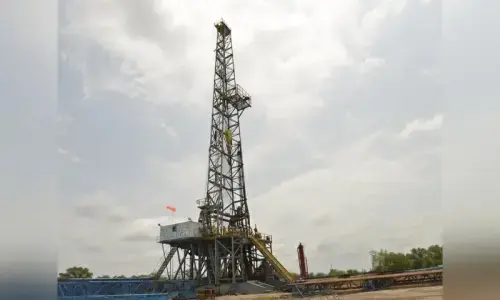
ISLAMABAD: In a major development, the Energy Information Administration (EIA), the American federal authority on energy statistics and analysis, has estimated fresh recoverable shale gas reserves of 105 trillion cubic feet (TCF) and more than nine billion barrels of oil in Pakistan.
These estimates of recoverable hydrocarbon reserves are many times larger than so far proven reserves of 24 TCF for gas and about 300 million barrels for oil. Pakistan currently produces about 4.2 billion cubic feet of gas and about 70,000 barrels of oil per day.
A government official said the new estimates appeared to be ‘very very encouraging’ but it had not been shared with the government of Pakistan. He said the shale gas had seen tremendous developments in the United States and a couple of other countries were trying to use the latest technology. Pakistan, he said, was also encouraging exploration and production companies to venture into the fresh horizon.
According to a June 2013 estimates of the EIA based on surveys conducted by Advanced Resources International (ARI), a total of 1,170 TCF of risked shale gas are estimated for India-Pakistan region --584 TCF in India and 586 TCF in Pakistan.
In case of Pakistan these estimates are backed by proven studies and verified technical data “The risked, technically recoverable shale gas resource is estimated at 201 TCF, with 96 TCF in India and 105 TCF in Pakistan,” said the EIA.
The EIA also estimated risked shale oil in place for India/Pakistan of 314 billion barrels, with 87 billion barrels in India and 227 billion barrels in Pakistan. “The risked, technically recoverable shale oil resource is estimated at 12.9 billion barrels for those two countries, with 3.8 billion barrels for India and 9.1 billion barrels for Pakistan,” the EIA said.
The southern and central Indus basins are located in Pakistan, along border with India and Afghanistan which are bounded by the Indian shield on the east and highly folded and thrust mountains on the west.
The lower Indus basin has commercial oil and gas discoveries in the Cretaceous-age Goru Fm sands plus additional gas discoveries in shallower formations. The shales in the Sembar Formation are considered as the primary source rocks for these discoveries.
The EIA said that while oil and gas shows have been recorded in the Sembar Shale on the Thar Platform, no productive oil or gas wells have yet been drilled into the Sembar Shale.
About the resource assessment, the EIA said that within 31,320 sq miles of dry gas prospective area, the Sembar Shale in the lower Indus basin had a resource concentration of 83 billion cubic feet per square mile. Within the 25,560 square mile wet gas and condensate prospective are, the Sembar shale has resource concentration of 57 BCF per sq. miles of wet gas and nine million barrels per square mile of condensate. Within the 26,700 square miles oil prospective area, the Sembar Shale has a resource concentration of 37 million barrels per square mile.