0
0
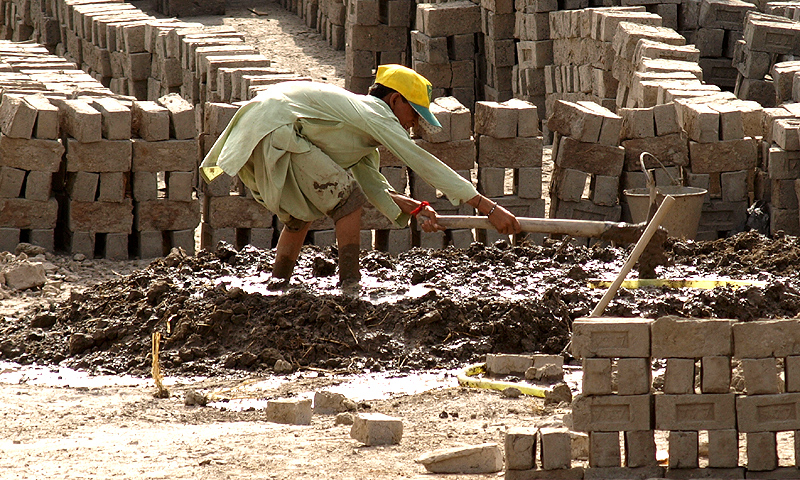

LARKANA: Highly underpaid workers of brick kilns and nearby population are fast falling victim to a host of diseases caused by thick black smoke and fine particles of ash arising from the kilns’ chimneys everday. Dr Partab, professor of ophthalmology at the Chandka Medical College, told Dawn that young kiln workers were often found to be suffering from blephritis, stye, chalazion and conjunctivitis and middle aged workers usually contracted dry eye syndrome, recurrent keratitis, corneal opacities. He said that conjunctival degeneration, sun eclipse, macular degeneration, skin cancer and other disorders were found in old aged kiln workers.
“We are prone to not only eye diseases but also skin illnesses which eat up our paltry savings and often leave us highly indebted,” said Abdul Rasool Chandio who works at a kiln in Bero Chandio village, 20 kilometres from here.
He said the abject poverty and sky rocketing prices of essential commodities barely left them any extra amount to meet healthcare expenses.
He said in the presence of kiln owner that they were highly underpaid and deprived of all basic facilities but added in the same breath they had no other option.
He said that they had to go through very hard times during closure of kilns from May to July when they were left by kiln owners to fend for themselves.
Barely 10-year-old Sajjad Dayo, who works at the kiln as a loader, said that he had to travel five kilometres daily to reach the workplace.
He said that he and his brother worked at the kiln to feed their 15-member family. “I get Rs200 to 300 a day for loading and unloading unbaked bricks from and onto donkey carts,” he said.
He said that he had been working for three years. “I should have been in a school at this age but I and my family can’t afford this luxury,” he said.
There were more than 30 kilns only in Bero Chandio, a small village of 3,000 souls, said Akhtiar Ahmed Chandio, a kiln owner.
He said the bricks sale peaked during November and April when kilns engaged around 150 to 200 workers for different jobs.
Akhtar Ali who suffered from a skin disease said he began working at kilns at the age of 10 and now he was 40 plus, still trying to eke out a living and feed the family with the Rs300 a day he earned.
Father of two sons and three daughters, he said that skyrocketing prices of food items had broken their backs. If someone fell sick in the family he mostly had to take loan from kiln owner to pay health bill and pay back the loan in instalments, he said.
When asked could he ever buy new clothes for his children on Eid, he replied in the negative.
Prof Abdul Manan Bhutto and Akbar Bhutto, associate professor of dermatology and pulmonology at the Chandka Medical College, said they frequently found a variety of skin problems in kiln workers.
Fine dust particles and smoke emitting from the kilns caused asthma, allergy, generalised eczema and secondary infection of hands and feet in kiln workers, they said.
Manan Bhutto said he feared these diseases were on the rise in the area.
The conjunctivitis was also found in the kiln workers, they said.
He said that contact dermatitis was also commonly found in people living near kilns. “Since they can’t afford routine healthcare expenses they come to us only when their condition deteriorates,” he said.
Dur Mohammad Detho, owner of a kiln who is in the business for 15 years, said that a brick maker earned Rs500 a day for making 1,000 bricks.
But the kiln workers disputed his claim and said they earned only Rs250 a day and had to take loans from the owners to meet emergencies.
Mr Detho said they purchased mud at Rs600 to 900 per tractor-trolley. Monsoon season was dangerous for them as most unbaked bricks were damaged in heavy rains, inflicting colossal losses on kiln owners, he said.
He said they feared that the government’s plans to lease out the railway’s vacant land would have drastic impact on kilns which were mostly set up on vacant land along railway tracks and roads.
If it was done it would render thousands of kiln workers and others linked directly or indirectly with kilns business jobless, said Mr Detho.
He complained about high-handedness by the officials of the excise and taxation and labour departments who, he said, continuously buggered them to get their palms greased.
A kiln owner said on condition of anonymity that once he dared to decline to come to terms with a labour officer who punished him by taking him to court and slapping on him a variety of charges, which adversely affected his business.