The army and the elections in Taxila: Security concerns and defence installations limit campaigning


 0
0

The relative safety enjoyed by political candidates in Punjab has meant that most of them have been able to campaign freely. However, in Taxila tehsil, high security around defence installations means the political candidates cannot move freely. Kalbe Ali explores the campaign in Taxila, Rawalpindi district’s NA-53. Punjab might have been lucky to avoid terrorist attacks under the election campaign, but that does not make life easier for politicians campaigning in Taxila.
As a part of Rawalpindi district’s NA-53 — which includes the Adiala area, cutting off at the motorway near Chakri — Taxila houses the majority of voters that will cast their ballot on May 11.
The presence of sensitive security installations —including Pakistan Ordinance Factories (POF) Wah, Heavy Industries Taxila (HIT), Heavy Mechanical Complex (HMC), and the Project Management Organization (PMO) — means that the local police are on the watch for any potential threats.
“The law enforcement is under severe pressure to make sure nothing happens in the run-up to the election,” says a police officer who prefers not to be named.
“Remember Faisal Shehzad, the Taxila resident who used to work in POF Wah,” he continued, referring to the man who harboured suicide bombers in 2008 —the attack ended up killing more than 70 POF employees.
Shazad was arrested and later released — he died in August 2012 while attacking the Pakistan Air Force base in Karma 20 kilometres from his hometown of Taxila.
“Faisal Shazad’s family has already held a political gathering, indicating that anyone in this area can penetrate political rallies. The combination between security installations and politicians campaigning means that we get nervous,” says the officer.
The area’s two border crossings into Khyber Pakhtunkhwa — a hotbed for attacks against political rallies — and reports of high-level terrorists moving around in Taxila has made the security institutions very nervous.
According to the officer, the local police force is holding regular meetings with the Inter-Services Intelligence (ISI), Military Intelligence (MI), Field Investigation Unit (FIU), and other local intelligence institutions.
“We are always concerned about miscreants moving in and out of Taxila,” says the officer.
Politicians on guard
The heightened security alert has forced candidates to restrict their movements, making it increasingly difficult for them to campaign freely.
“The law enforcement has visited my house frequently,” says Pakistan People’s Party (PPP) candidate, Syed Intekhab Hussani Shah. The former judge is a Shia, and both he and the police are concerned for his safety. “Despite their visits, however, they have not given me any protection,” says Shah.
Taxila has a brief history of sectarian and religiously motivated attacks. In 2002, a Christian chapel housed in a hospital was bombed, killing three people including two female nurses and a paramedic.
Even, the Pakistan Muslim League-Nawaz (PML-N) stalwart, Chaudhry Nisar Ali Khan, took extreme precaution last week despite his notorious friendly relations with hardliners in Taxila and its surrounding areas.
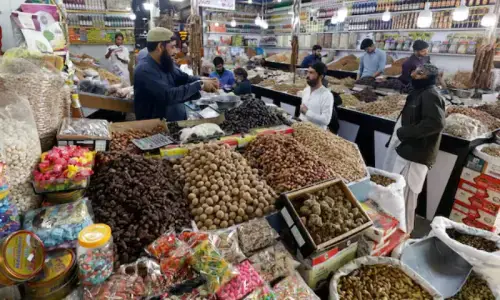
When he inaugurated his election office in Taxila’s vegetable market, he stayed put in his car–his supporters brought the ribbon to him, holding it straight while he scissored it into two pieces.
However, the concerns of political party candidates are only part of the problem.
The presence of security installations—and there are more than the POF, HIT, and HMC (some are related to defence production) —means security managers are concerned that massive public rallies could mean that their systems would be attacked.
The HMC already imposed restrictions on political activities in the last week of March 2013, arguing that there would be too many “non-concerned persons” moving around close to very sensitive installations.
Unfortunately for the HMC, they were unable to enforce their decision.
“It is wrong to bar political activities at this time–it is our right and we will not forego our right,” said Dastar Shah, a PPP worker in the area.
However, while it was easier to thwart the directives of the HMC—they have a civilian administration—HIT which is managed by the serving military personnel is a whole other story.
“They have closed the installation, and we have had to establish our camps outside the gates of HIT,” said Malik Moid, a PML-N supporter. “Because of their closure, we cannot campaign among women and the young—we are only in contact with workers who come out of this walled city or those who have a cell phone so we can send them an SMS.”
According to local political activists, there are around 13,000 votes in and around HMC and HIT. POF Wah has even more—a huge vote bank of around 150,000 votes.
The POF management was last in the row of security institutions taking extraordinary precautions regarding electioneering.
After serious negotiations with the unions, POF imposed a ban on all political activities in the estate area, including POF residential quarters, factories and grounds and parks.
Hoisting political flags, pasting posters, or holding small gatherings is now banned—not even at Wah’s largest and most centrally located market, the Aslam market.
Political activities are only allowed in other markets and few private residential areas around Wah Cantt.
“They do not let us hold rallies. Security wardens even stop motorcycles with posters of our leader,” said Mohammad Kamran, a young and enthusiastic Pakistan Tehreek-i-Insaf worker.
Unlike previous elections, political parties are forced to hold their gatherings outside Wah Cantt, just next to the main Grand Trunk Road—but even that increases the risks to the political candidates.
“What can we do? The concerns of security personnel are genuine. Let’s pray that things go smoothly; Mian sahib is expected here on May 6,” said Imran Haider, a local PML-N activist.