0
0

ISLAMABAD, June 14: A conference on ‘Empowering women in politics through media’ brought together women parliamentarians from across Pakistan, including Gilgit, Balochistan, KP, Sindh and Punjab.
The objective was to bring together not just women political leaders but also media and civil members “to think about ways in which the media could be made aware of how important it is to be gender sensitised so that women’s cause is effectively promoted,” said director UKs at a local hotel.
The elections last month noted a changing demographic of voting patterns, with turnout recorded at 60%. According to statistics, 37 million women were registered to vote. Aside from this, many women competed with political stalwarts for seats in the national and provincial assemblies.
Despite this, many electoral observers remained disappointed by major political parties, including the PPP, PML-N, JUI and PTI, for tacitly agreeing to discourage female voters in certain constituencies such as Upper and Lower Dir.
Bina Shah, a writer, termed this “a serious crime.”
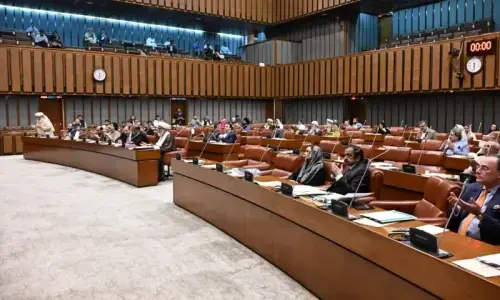
The effort to enfranchise women through reserved seats has increased their representation in the assemblies. But this move has also been criticised by many quarters for empowering only the upper-class women who represent vested political interest rather than mobilising the middle-class women and those who are politically active at the grass-roots.
According to the director Uks, women elected to the National Assembly drew the media attention on the inaugural session of the house for their designer floral outfits, the jewelery they adorned and colours of their ‘chadars.’
“The airtime given to this kind of derogatory content, accompanied by equally insensitive songs and music, was not needed,” she argued.
Rana Jawad, the bureau chief of a private TV channel, said, “These women represent the beautiful faces of Pakistan.”
However, many women parliamentarians noted that such statements objectified them; the focus instead should have been on constituency politics. While this kind of coverage may be entertaining, it promotes stereotypes that strengthen a patriarchal attitude.
A perception is created that women are worthy as long as they look good. It is important to change this idea and address issues that perpetuate inequality, civil society members reasoned.
The conference was attended by several women leaders and aspiring politicians. Among them were Shama Bhittani, Shameela Aslam, Raheela Durrani, Anila Shaheen and Noorul Ain.