IT is not clear how serious Mr Zardari is about his oft-repeated pronouncement of 'changing the system'. Presently there is no evidence to suggest that any such thing is being contemplated in Islamabad.
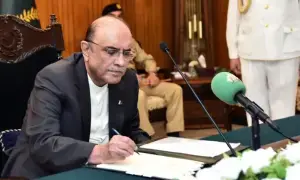
The oath-taking (is it really necessary for good Muslims?) in a foreign language by members of a massive cabinet in the stately and opulent President House in the presence of the rich and the powerful and the rush to seek armed escorts, flagged cars and ministerial accommodation by the dozens of new cabinet members do not give us much hope for a change in the system. Ours has become a celebratory democracy.
One can argue endlessly about the flaws in our political, economic and social systems but it is the way our ever-growing and massive government functions and the way our leadership succumbs to the trappings of power that need to be addressed first in order to move towards a pragmatic reassessment of the inadequacy of the whole system. The parliamentary system has been completely contaminated during the last decade and the powerful military president has now been replaced by an even more powerful civilian president who may yet — some people hope — bring about the much needed reforms.
But maybe not. Mr Zardari seems more of a victim of history rather than its beneficiary who finds it difficult to let go of the great opportunity of exercising unlimited and uncontrolled power. The illegitimate presidential system fathered by Gen Musharraf is alive and kicking.
Just like Gen Musharraf, Mr Zardari has managed to make his prime minister a virtual principal staff officer. (Mr. Bhutto did the reverse when he introduced a puppet president to the nation.) Maybe this is good, as Mr Zardari has shown a lot more spunk than any other leader of the PPP and also commands the undisputed support of the party.
But by just controlling policy Mr Zardari cannot change the system. He has unwittingly allowed the parliament to become a glorified 'chopal',where inter-party rivalries set the tone for debate and discourse. Legislation in pursuit of excellence and resolving issues is unheard of as most parliamentarians seem to be unaware of the complexity of issues. The presidential ordinance remains a preferable instrument of change.
To be fair a resolution of the immense problems we currently face requires an extended period of time. But it also requires a determination and vision which seems to be lacking in our leadership. The long, agonising wait for democracy desperately needs to be tempered with hope and opportunity for the people.
But our leadership has yet to demonstrate any competence in providing that to the impoverished masses. It has become entangled in the complexities of a presidential-parliamentary system trying to hold on to the threads of a weakening, artificial alliance. The task of nation-building has been sacrificed for maintaining a precarious political balance.
A shameful feudal-bureaucratic-crony mafia seems to be emerging in defiance of the people's will. Henry Kissinger's dictum that power is the ultimate aphrodisiac is proving to be more than true in our beloved homeland as this mafia aims for the stars in its attempts to consolidate its hold on power and the sources of power. Self-interest seems to carry precedent over the general good of society. The people's representatives are required to be subservient to this scheme of things in order to maintain their presence in the corridors of power.
The most disturbing aspect of the ruling elite is its insouciance. Unfortunately it is becoming endemic and the intelligentsia is also getting affected. Unable to do much except talk and write, our intellectuals are getting despondent at the futility of their outpourings. The vicious system continues to stifle the spirit of the free mind.
Today all our parliamentarians are guilty of this indifference; their collective and individual failure to legislate for the good of this country, to provide for the poor and to attack what is wrong has been overtaken by their desire to enjoy the fruits of affluence.
As poverty continues to grow like an epidemic, our government has, like the previous government, continued to ignore this issue. The government colleges for the poorest are charging Rs1,000 as admission fees and the required character certificate from the government schools costs Rs300 for every student. The board examination fee is also close to Rs1,000. This is a blatant attack on the dignity of the poor and is designed to discourage the poor from sending their children to school. A reminder of the psyche of the ruling elite. We can of course blame the system for this. But then who is responsible for changing the system?
Our history has shown that large cabinets lead to inefficiency and waywardness. Today our economy is being handled by half a dozen different ministries who lack not only a common vision but also any coordination. As usual the government is fumbling in the dark. There is no economic policy in place and the ad hoc approach adopted by our de
cision-makers is full of contradictions. The raising of interest rates amounts to a deliberate attempt to stifle the economy, create unemployment and slow down economic growth. Previous attempts to check inflation by raising interest rates have failed miserably in our country.
Consider what Paul Krugman, the Nobel Prize-winning economist, said this week in an article “When depression economics prevails, the usual rules of economic policy no longer apply virtue becomes vice, caution is risky and prudence is folly.” He goes on to say “To pull us out of this downward spiral, the federal government will have to provide economic stimulus in the form of higher spending and greater aid to those in distress”.
Although Krugman is talking about America, this statement is equally applicable to Pakistan. But our ruling elite, who have shown remarkable resistance to new ideas, are determined to follow a failed strategy. We have become a nation of 'ill' literates.